|
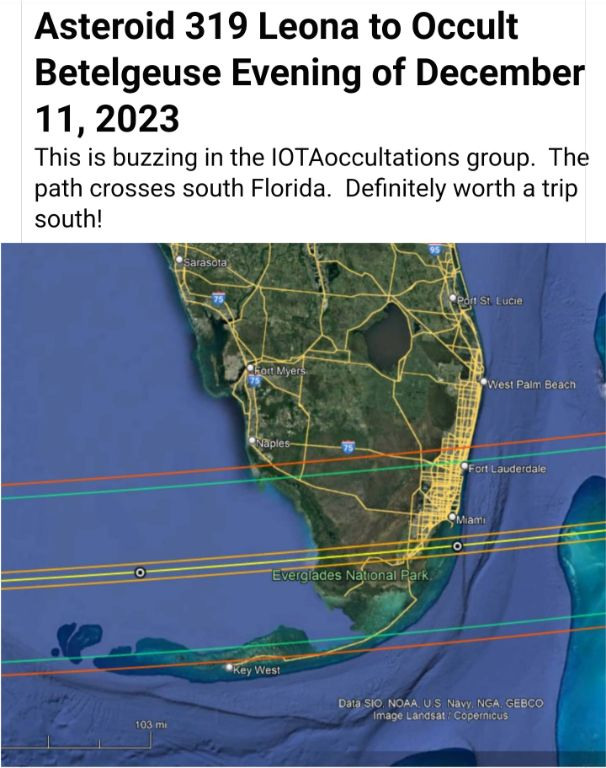
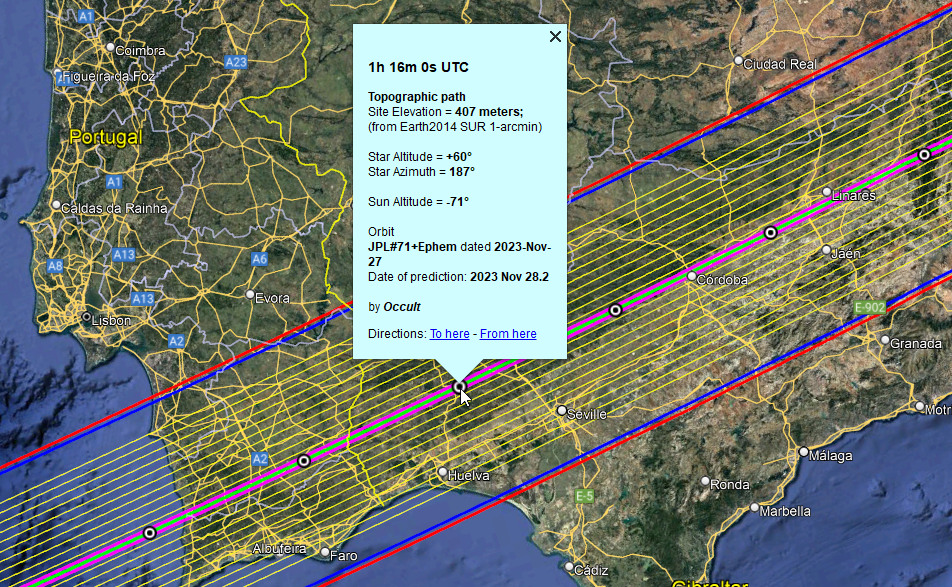
One of the most famous stars in the night sky is about to disappear. On Dec. 12th (Dec. 11th in the USA), asteroid Leona will pass directly in front of Betelgeuse for an extremely rare occultation visible from south Florida to Italy. Sky watchers in the "path of totality" can look up and see the red giant vanish, dramatically altering the appearance of the constellation Orion. 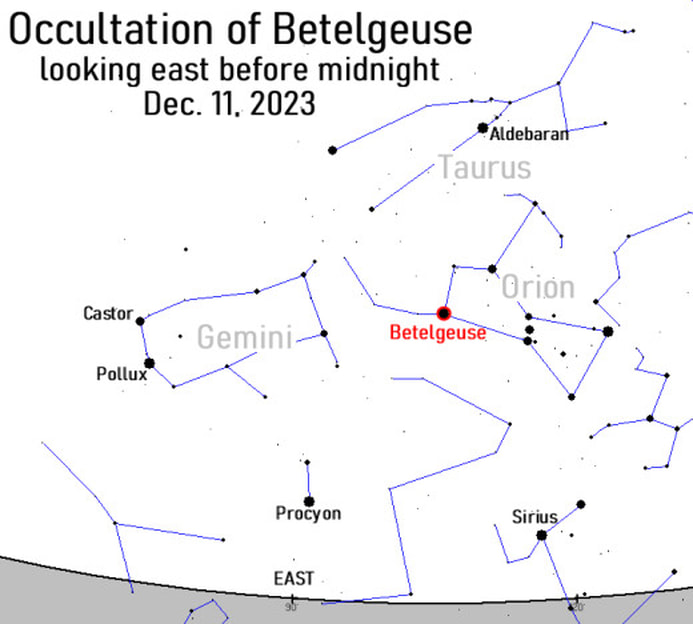 There are huge population centers in the occultation path, especially in south Florida where Leona's shadow crosses Miami and Fort Lauderdale. For observers there, Betelgeuse will wink out for about 10 seconds on the evening of Dec. 11th just before 8:25 pm Eastern Standard Time. In Europe, the occultation happens on Dec. 12th between 1:10 UT and 1:16 UT. To find out when to look from your location, we recommend downloading this excellent Google Earth file; when viewing the map, click on the little dots for occultation times.
https://spaceweather.com/ NOAA models confirm that a Cannibal CME will strike our planet on Dec. 1st. Cannibal CMEs form when a fast CME sweeps up a slower CME ahead of it. The combination contains intense, tangled magnetic fields that can do a good job sparking auroras when they reach Earth. If a Cannibal CME strikes Earth on Dec. 1st, as predicted, geomagnetic storm levels could reach category G3 (Strong). If so, here's what we can expect. The last G3-class storm on Nov. 5th sparked not only bright auroras, but also deep-red SAR arcs around the world. Greg Redfern photographed this example from the Shenandoah National Park in Virginia: 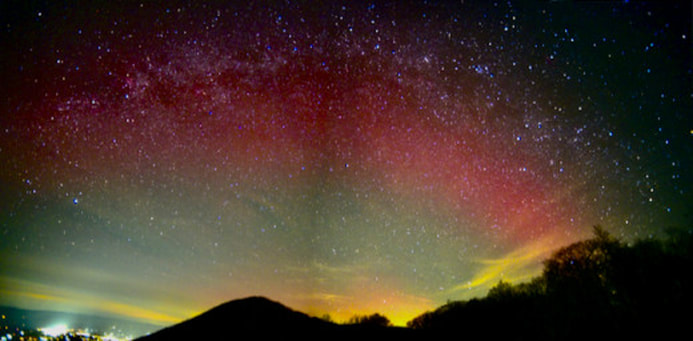 "I didn't realize I had photographed an SAR arc until I processed my images the next day, stitching two of them together to reveal its shape," says Redfern. SAR arcs look like auroras, but they are not. They are the glow of heat energy leaking into the upper atmosphere from Earth's ring current system–a donut-shaped circuit carrying millions of amps around our planet. During the Nov. 5th geomagnetic storm, these red arcs were observed as far south as Texas and California. Auroras were observed as well -- "and they were INSANE," says Janne Maj Nagelsen, who watched the display from Stamnes, Vaksdal, Norway: 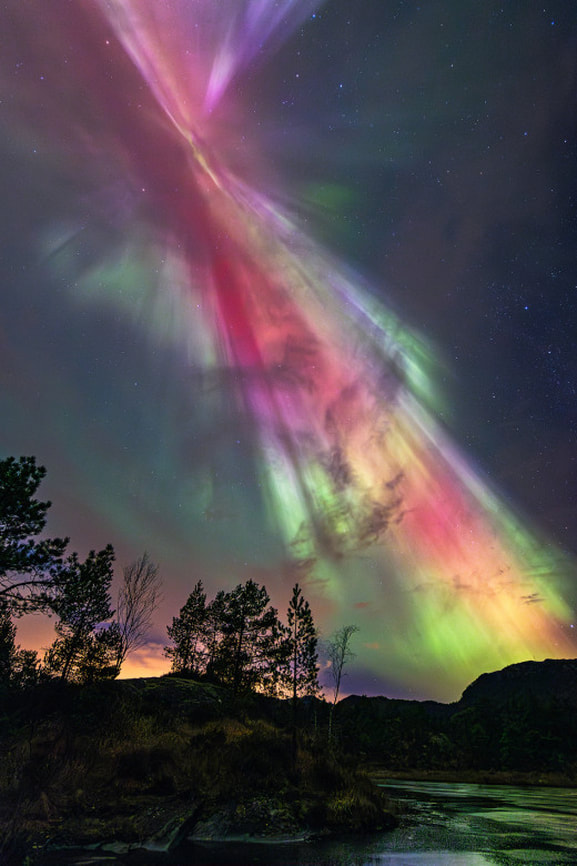 "I have never seen such strong auroras," says Nagelsen. "Not to mention the colors. I mean look at the picture! They were totally, literally insane."
Auroras are caused by charged particles raining from space down upon Earth's atmosphere. Unlike SAR arcs, which are pure red, auroras can have a rich and stunning variety of colors. Both phenomena may be photographed on Dec. 1, 2023, when a Cannibal CME is expected to hit Earth. https://spaceweather.com/ If you’re constantly creating light, then darkness does not have a chance.
We’ve said this over and over and now it comes full circle to you personally: Wherever you go, darkness can’t touch you. Are you listening to me? It can’t touch you. The essence of your light is the love of God and you are broadcasting it. Lightworker – broadcast it! There’s no dark thing that can get in there as long as you’re broadcasting light! ~ KRYON Through Lee Carroll, the Original Kryon Channel (via gary@kryon.us) P.S. To fully explore this topic, you can download from Kryon Book XIII - The Recalibration of Humanity through Kindle. We are so aware that many of the events we’re currently experiencing are some of the most challenging and horrific things that shock us to our core.
We are witnessing first hand the battle between dark and light. The battle taking place on Earth is a result of the Shift in consciousness. As greater amounts of light flood our planet, the darkness is being exposed, making it more readily seen. What do we do when we see a war happen? How do we help those who are going through such great sorrow? How can we help others when we feel our own ability for compassion has been disabled? That’s what we’d like to talk about in this brief message, so that you know compassionate action is needed now more than ever. In this video (Kryon - Disabling the Darkness), we share how we can disable the darkness and hear from Kryon about how we can create greater states of global peace. In short, the way we do this is by "tempering our empathy." The darkness wants us to be in fear and remain in that lower state of being. (This is how it survives.) And so, we’re asked to walk in compassionate action; where you can feel, sense, or visualize the painful events that are occurring and those who are experiencing them, and create a new vision of them in a state of joy and inner peace. See them laughing; see the God that lives within them. As you do so, you actively send out ripples of love, thereby neutralizing and transmuting the darkness. Now, if you are one who is reading this and are going through trauma and suffering, know that you are not alone and that all around the world people are sending you love and benevolence. There is so much compassion for all of you, who came to Earth knowing that you would be here in a time where humanity was evolving in consciousness. You are so dearly loved by Spirit. In times like these, it’s more important than ever that we all remain aware of the God inside. By keeping our focus on better days ahead and the peaceful future that awaits us, we are actively creating it. For all beings. Know that you are here on purpose. Together, we disable the darkness and activate the light. To the vision of peace and benevolence for all, ~Lee & Monika As Human Beings, you may be forced to redefine what “life” is.
We’ve spoken of interdimensional life in the past. Now here’s your opportunity to discover it. There is life in ordinary water. Not the kind of water that you’re going to create with intent or alter magnetically – I’m talking about water that’s normal on the planet, which bubbles out of the ground. Interdimensional life is everywhere. This is the force that receives the intent that changes the water as it’s ingested, and works with your DNA. Did you ever wonder what it is in water that can do so much? Do you think it’s within the simple few molecules of water? It’s more than that, dear Human Beings. There has to be another force on the planet in order to cooperate with you and the field that you put out. Interdimensional life is the answer. ~ KRYON Through Lee Carroll, the Original Kryon Channel (via gary@kryon.us) From Kryon Book X – A New Dispensation – Page 89 To fully explore this topic, you can download From Kryon Book X - A New Dispensation through Kindle. Mercury and Mars are converging for a conjunction in the constellation Libra. The action is happening too close to the sun to see with the human eye, but coronagraphs on the Solar and Heliospheric Observatory (SOHO) are getting a great view of the action:  At closest approach on Oct. 29th, the two planets will be only 20 arcminutes apart--a remarkable pair. If this were happening in a dark night sky, it would be headline news.
In a few months, it will be headline news. Mars and Mercury will loop around the sun for another even closer conjunction on January 27, 2024. During the event, the planets will be only 12 arcminutes apart--almost as close as Jupiter and Saturn were during the Great Conjunction of 2020. Both planets will be visible to the naked eye in the morning sky just before sunrise. Stay tuned. www.spaceweather.com
Sky watchers across the Americas witnessed a rare annular solar eclipse on Oct. 14th. The moon glided dead center across the solar disk, turning our star into a beautiful "ring of fire". Photos are pouring in from the eclipse zone. Check out our realtime gallery for the latest. In Nevada's Valley of the Moon (yes, that's a real place), Dr. Tony Phillips video-recorded the ring of fire through a bank of filter-perfect clouds:
Ring of Fire from Earth to Sky Calculus on Vimeo.
At the same time, two Earth to Sky Calculus helium balloons were en route to the stratophere on a mission to photograph the Moon's shadow from above. We might not know the results for a few days while the payloads are being recovered from remote wilderness areas. Stay tuned!
https://spaceweather.com/ Recent measurements by NASA's Solar Dynamic Observatory reveal a rapid weakening of magnetic fields in the polar regions of the sun. North and south magnetic poles are on the verge of disappearing. This will lead to a complete reversal of the sun's global magnetic field perhaps before the end of the year. 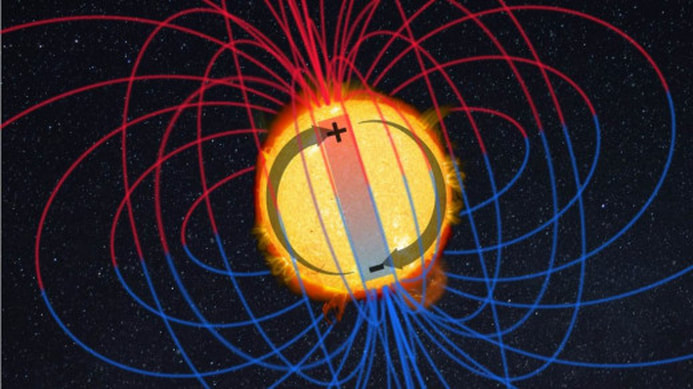 An artist's concept of the sun's dipolar magnetic field. Credit: NSF/AURA/NSO. If this was happening on Earth there would be widespread alarm. Past reversals of our planet's magnetic field have been linked to calamities ranging from sudden climate change to the extinction of the Neanderthals. On the sun, it's not so bad. "In fact, it's routine", says Todd Hoeksema, a solar physicist at Stanford University. "This happens every 11 years (more or less) when we're on the verge of Solar Maximum." Vanishing poles and magnetic reversals have been observed around Solar Max in every single solar cycle since astronomers learned to measure magnetic fields on the sun. Hoeksema is the director of Stanford's Wilcox Solar Observatory (WSO), that is observing its fifth reversal since 1980.  The last five polar field reversals observed at the Wilcox Solar Observatory (inset) "One thing we have learned from these decades of data is that no two polar field reversals are alike," he says. Sometimes the transition is swift, taking only a few months for the poles to vanish and reappear on opposite ends of the sun. Sometimes it takes years, leaving the sun without magnetic poles for an extended period of time. "Even more strange," says Hoeksema, "sometimes one pole switches before the other, leaving both poles with the same polarity for a while." Indeed, such a scenario could be playing out now. The sun's south magnetic pole has almost completely vanished, but the north magnetic pole is still hanging on, albeit barely. How does all this affect us on Earth? One way we feel solar field reversals is via the heliospheric current sheet: 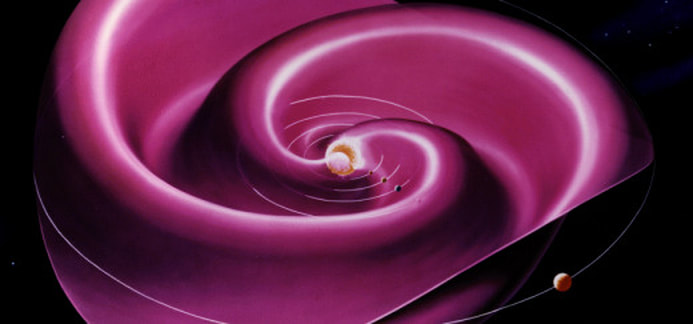 An artist's concept of the heliospheric current sheet. The sun is surrounded by a wavy ring of electricity that the solar wind pulls and stretches all the way out to the edge of the Solar System. This structure is a part of the sun's magnetosphere. During field reversals, the current sheet becomes extra wavy and highly tilted. As the sun spins, we dip in and out of the steepening undulations. Passages from one side to another can cause geomagnetic storms and auroras.
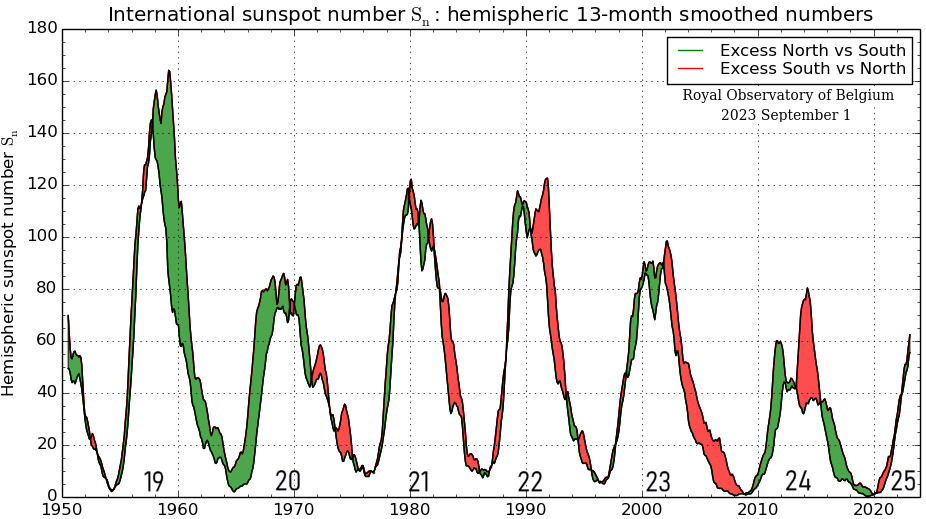
Most of all, the vanishing of the poles means we're on the verge of Solar Maximum. Solar Cycle 25 is shaping up to be stronger than forecasters expected, and its peak could be relatively intense. Stay tuned for updates! https://spaceweather.com/ For the second month in a row, sunspot counts in the sun's northern hemisphere are more than double the south. The asymetry is obvious in this summary of September's sunspots compiled by astronomer Senol Sanli using data from NASA's Solar Dynamics Observatory: 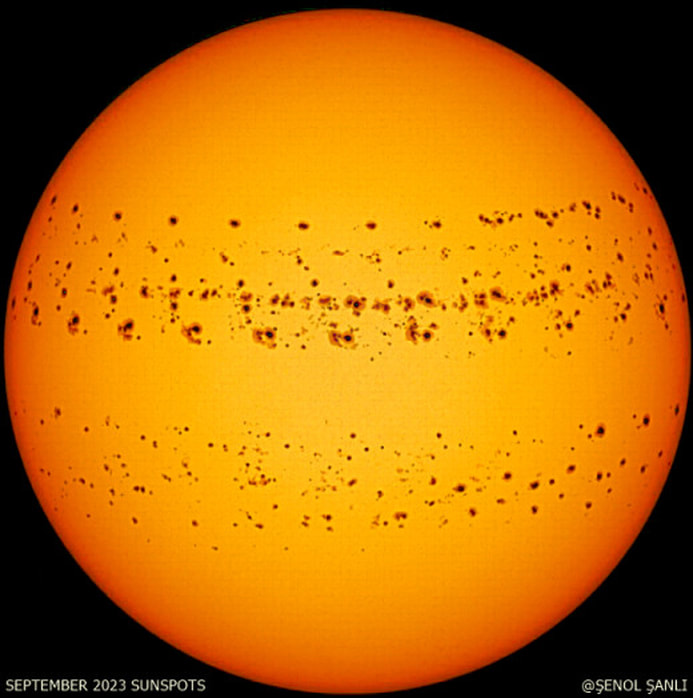 According to the Royal Observatory of Belgium's Solar Influences Data Analysis Center, in September the monthly sunspot number for the sun's northern hemisphere was 90, the southern hemisphere was only 44; that's a ratio of 2-to-1 in favor of the north. August was about the same. Looking back over an entire year, the north is leading the south by an average of 50%. What's going on? In fact, it's not unusual for the sun's northern and southern hemispheres to be out of synch. As long ago as the 19th century, solar cycle pioneers Spoerer (1889) and Maunder (1890) noted that there were often long periods of time when most sunspots were found preferentially in one hemisphere and not the other. This plot from the Royal Observatory of Belgium shows assymetries throughout the last 6 solar cycles: 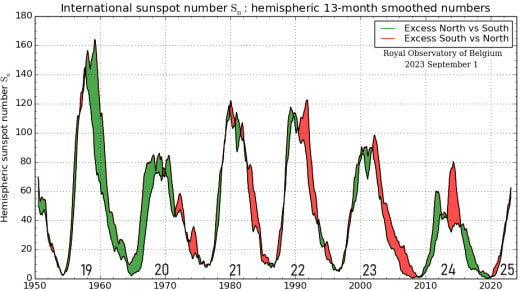 Until recently, Solar Cycle 25 was pretty evenly matched, north vs. south. Sunspot counts from August and September, however, suggest that the northern hemisphere may be seizing control--at least temporarily. This has happened during the upslope of all four previous solar cycles (21-24).
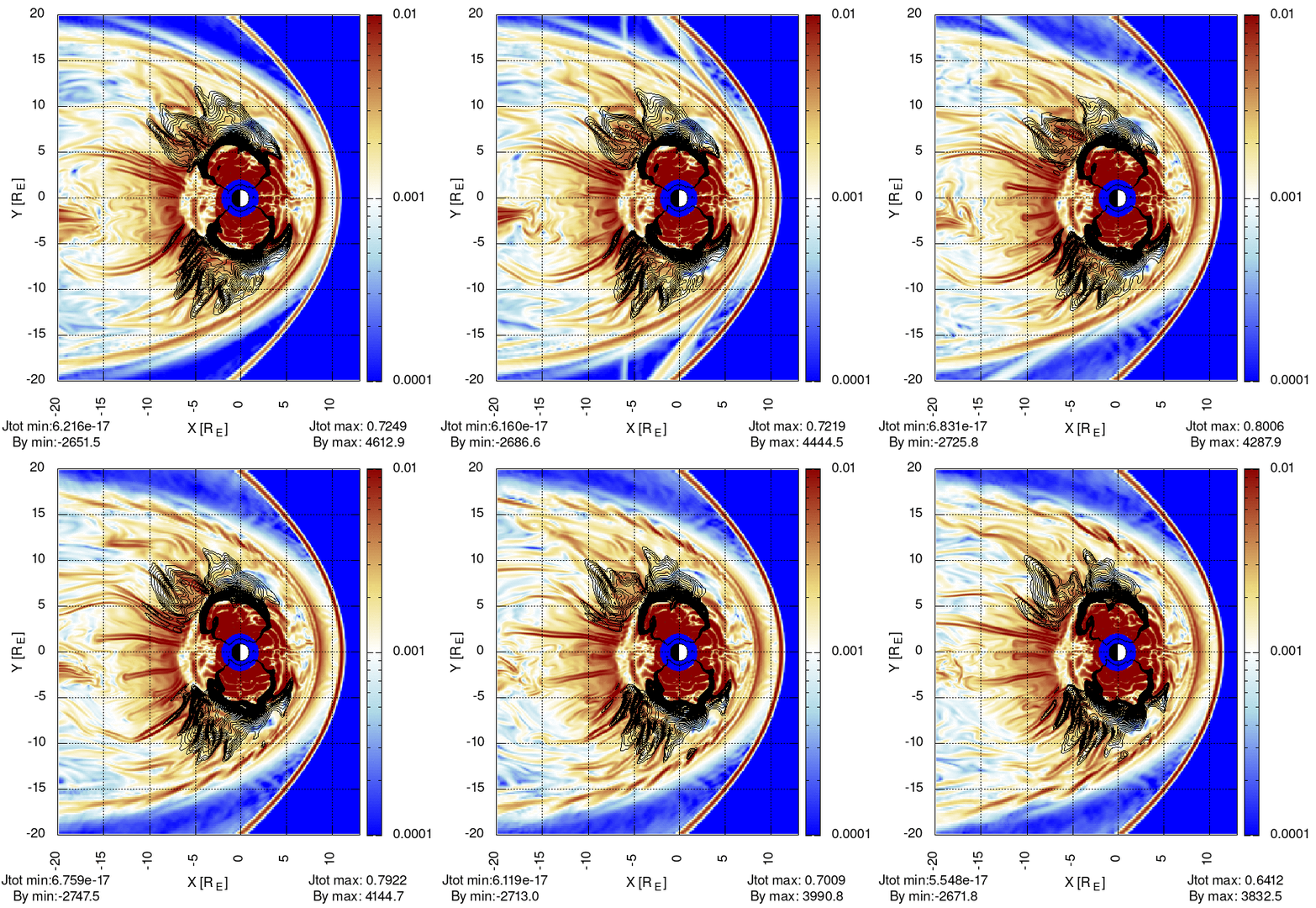
One possible explanation for this phenomenon may be that the two hemispheres of the sun have their own solar cycles, one out of phase with the other by about a year. Indeed, Solar Max is often double peaked. You can see it in the hemispheric sunspot plot. In the three most recent cycles (22-24), north peaked before south, creating two surges of solar activity separated by a "Gnevyshev gap." Solar Cycle 25 might continue this trend. A complete discussion of sunspot asymmetries is included in David Hathaway's excellent review article "The Solar Cycle." https://spaceweather.com/ When Vincent van Gogh painted "The Starry Night" in 1889, little did he know he was working at the forefront of 21st century astrophysics. A paper recently published in Nature Communications reveals that the same kind of waves pictured in the famous painting can cause geomagnetic storms on Earth. 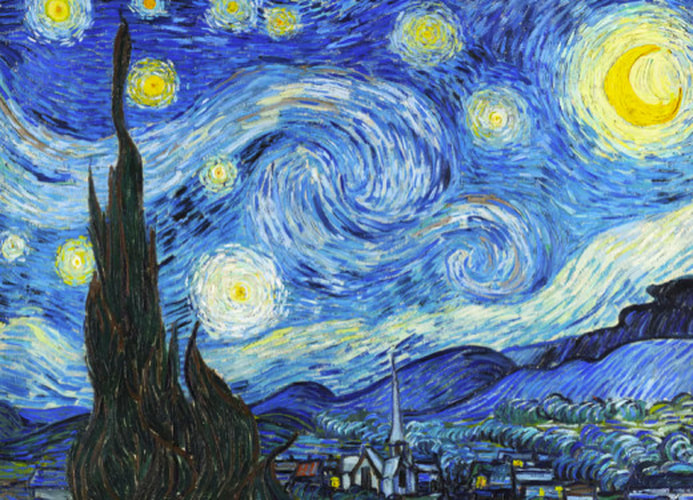 Above: Vincent van Gogh's 'Starry Night', which he painted in 1889 Physicists call them "Kelvin Helmholtz waves". They ripple into existence when streams of gas flow past each other at different velocities. Van Gogh saw them in high clouds outside the window of his asylum in Saint-Rémy, France. They also form in space where the solar wind flows around Earth's magnetic field. "We have found Kelvin-Helmholtz waves rippling down the flanks of Earth's magnetosphere", says Shiva Kavosi of Embry–Riddle Aeronautical University, lead author of the Nature paper. "NASA spacecraft are surfing the waves, and directly measuring their properties". This was first suspected in the 1950s by theoreticians who made mathematical models of solar wind hitting Earth's magnetic field. However, until recently it was just an idea; there was no proof the waves existed. When Kavosi's team looked at data collected by NASA's THEMIS and MMS spacecraft since 2007, they saw clear evidence of Kelvin Helmholtz instabilities. "The waves are huge" says Kavosi. "They are 2 to 6 Earth radii in wavelength and as much as 4 Earth radii in amplitude."  This computer model shows van Gogh waves moving down the flank of Earth's magnetosphere. Credit: Shiva Kasovi. [full-sized animation] Imagine a wave taller than Earth curling over and breaking. That's exactly what happens. Kelvin-Helmholtz waves naturally break onto Earth's magnetic field, propelling energetic particles deep into the magnetosphere. This revs up Earth's radiation belts, triggering geomagnetic storms and auroras.
A key finding of Kavosi's paper is that the waves prefer equinoxes. They appear 3 times more frequently around the start of spring and fall than summer and winter. Researchers have long known that geomagnetic activity is highest around equinoxes. Kelvin-Helmholtz wave activity could be one reason why. Our planet's seasonal dependence of geomagnetic activity has always been a bit of a puzzle. After all, the sun doesn't know when it's autumn on Earth. One idea holds that, around the time of the equinoxes, Earth's magnetic field links to the sun's because of the tilt of Earth's magnetic poles. This is called the Russell-McPherron effect after the researchers who first described it in 1973. Kavosi's research shows that Kelvin-Helmholtz waves might be important, too. Northern autumn has just begun, which means Kelvin Helmholtz waves are rippling around our planet, stirring up "Starry Night" auroras. Happy autumn! www.spaceweather.com |
QUICK INFO
Author:
Messenger Spirit This section is for interesting items which are brought to my attention but which do not merit a separate article.
I welcome your comments, questions or suggestions on any topics you wish to contribute to this section. Please submit these on the Contact and Feedback Form PLEASE DO NOT SUBMIT COMMENTS ON THE FORM WHICH APPEARS UNDER ITEMS ON 'QUICK INFO'; THIS SYSTEM IS NOT WORKING. Categories
All
Archives
April 2024
|
- HOME
- RECENT ARTICLES
- ALL ARTICLES
- QUICK INFO
- MAILING LIST
- CONTACT/FEEDBACK
-
REALITY
- The Nature of Reality
- You never left Home
- The Self-Aware Universe
- Univ. Dreaming Itself Awake
- Is the Universe a Fractal?
- Evidence That Consciousness Creates Reality: Welcome To The Matrix
- The Whole of Reality Glows With Life
- Does time exist? Quantum physics says no
- Three Scientific Fields That Are Helping to Evolve Humanity’s Worldview
- Why There Might Be Many More Universes Besides Our Own
- Paradigms are Made for Shifting
- The Science of Interconnectedness
- Distorted Reality – Recalling Different Events After Timelines Merge
- The Amazing Rise of the Mandela Effect!
- Expanding Our Awareness to See a Multidimensional Reality
- The Origin, Purpose, and Destiny of the Earth Game
- The Next Big Bang – Human Consciousness and the Universe’s Ultimate Secret
- Reality – Constructing the Separation Game
- Parallel Realities and the Multidimensional Universe
- Quantum Phase: Time, Parallel Realities and The Brain
- The Shift and The Quickening of Manifestation
- The Three Layers of Your Reality Construct
- Transcending the Realms of Duality and Separation
- How to Form Blueprints of Potential Realities
- New View of Consciousness/Reality >
-
A Holographic Universe?
>
- The Fractal Holographic Universe: Introduction
- The Holographic Paradigm : All is One
- The Spiral and the Holographic Matrix
- The Unified Field and the Illusion of Time: Understanding the Source of Creation
- Vacuum Energy: Proof of Free Energy in the Space All Around Us
- Spiral Vortex – Contemplative Exercise
- Attention, Intention & the Universe as a Conscious Holographic Information Processor
- Love Waves In Our Hologram
- Love, Creation and Morphic Resonance – The Formula for All Matters in The Love Hologram
-
CONSCIOUSNESS
- The Self-Aware Universe
- The Relationship between Human Consciousness and Earth Dynamics
- A Call to Conscious Evolution
- Electromagnetic Effects on Consciousness
- Lumen Octave Principles : Language of the Soul
- A Door Is About To Open!
- Accessing A Higher Level Of Consciousness (and The Ego: Our Greatest Teacher)
- Explorers of Higher Dimensions: The Power of Active Consciousness
- 20 Transformational Truths From Sages Throughout the Ages
- Mind Over Matter - Consciousness and the Nature of Reality
- Beyond Space and Time: Quantum Theory Suggests Consciousness Moves on After Death
- Neurosurgeon Who Doubted Afterlife Now Convinced It's Real
- A Neurosurgeon’s Journey to Worlds Beyond: An Interview with Dr. Eben Alexander
- Focus on Possibilities, Not Limitations.
- Cosmic Consciousness Phenomenon : The Overview Effect
- We Are Becoming Consciousness ItSelf
- Dimensions of Conscious Experience
- Mysterious Light : A Scientist's Odyssey
- From Science to God
- ONENESS : Transcending Duality
- This Body is Not Me
- The Rise of Empathic Consciousness
- Your Body is a Projection of Your Consciousness
- Evidence That Consciousness Creates Reality: Welcome To The Matrix
- Human Consciousness Is Taking A Quantum Leap: Lifting of the Veil
- Leading Neuroscientists & Buddhists Agree: “Consciousness is Everywhere”
- Be Careful, Consciousness Is Listening!
- Experiencing a Collective Shift Through Personal Transformation
- The Illusion of Time and Space
- The Emergence of Connected Consciousness
- Reality & Experience: Morphic Fields & The Power Of Choice
- You Are The One – The Universe is Moving Within You
- Conscious Creation: Becoming an Observer of Your Own Life
- The War On Consciousness
- The Multidimensional Self: The Soul, OverSoul, and Beyond
- The 2020 Parting of the Waves: Which Flow are You Riding?
- We Have Arrived at the Dawn of the Unknowing
- The Most Suppressed Technology Today
- Children/Education >
- The Human Heart : The Intelligence of The Heart >
-
The Human Brain
>
- The Triune Brain
- The Split Brain
- The Holographic Brain
- Whole Brain Synchronization : Binaural Beats
- Mysterious Brain Of Daniel Tammet
- Consciousness/Brain
- What and Where is Consciousness?
- The Holographic Paradigm : All is One
- Electromagnetic Effects on Consciousness
- Exploring the Nature of Mind and our Holographic Brain
- Six Intriguing Types of Synesthesia
- Mysteries of the Pineal Gland Ignored by Mainstream Science and Research
-
HUMANITY
-
The Awakening
>
-
The Dark Night Of The Soul
>
-
Humanity : Body, Mind, Soul and Spirit
>
- Who Are You?:Deepak Chopra
- Solar Flares Affect Humans
- Univ. Unconditional Love
- A Prayer for the World
- Overcome the Ego
- Etheric Antenna: Chakras
- Your Aura and 12 Chakras: Keys to the Kingdom
- The Seven Bodies of Man
- The Journey
- A Spiritual Pilgrimage
- Science of the Soul
- We are Beings of Light
- Lumen Octave Principles : Language of the Soul
- God is Very Much Alive
- Tao: Your Cosmic Connection and Spiritual Contract
- The Three Births of the Human Spirit
- Unconditional Love?
- The Relationship between Science and Spirituality
- How Einstein Saw the World
- Conscious Partnership with Earth
- Infogr: Control your Dreams
- Your Cells When You Experience Happiness
- Aligning the Trinity – Body, Mind and Spirit
- Being Aware of Our Energy
- The Greatest Story Never Told
- The Alchemy of Groups
- Inevitable Change – Shattering Our Attachment to ‘Sameness’
- The Biocrystal
- Life after death: Hospice doctor studies the vivid dreams and visions of dying people that suggest comfort being given from the other side
- In Life and Death, Love is Our Legacy – The Courage to Open Our Hearts
- Attuning to the Flow of the Universe
- Waking Up From Religion
- Astral Dynamics : The Silver Cord
- The Spirit World
- Cycles of Soul Existence
- The Soul’s Journey After Death
- Life Between Lives
- 7000 Souls Recall Their ‘Life’ Between Lives During Regression Hypnosis, The Similarities Are Astounding
- The Life-Review Process
- We Are the Universe Becoming Aware of Itself
- Have You Realized The Profundity Of Our True Nature?
- Improving Your Connection To Spirit
- Aligning with Our Soul Purpose
- Spiritual Inspiration from Albert Einstein
- Spiritual but Not Religious? Why Spiritual Wellness Does Not Depend on Your Beliefs
- A Sense of Oneness Leads to Greater Life Satisfaction, Research Shows
- How to Transform Your Darkness Into Light
- You Are a Sovereign Being – Start Acting Like It!
- 5 Steps to Cultivate Patience Within Your New New Normal
- The Truth Will Set You Free, But First It Will Piss You Off
- Chaos Sorcery
- Science, Spirituality and Religion
- Shadow Work 101: Just Claim it All
- Staying Centered in a Wild World
- How Changing Your Thoughts Changes Your Life
- Victim or Creator?
- The “Seer” of all Things
- Discovering Our Earthly Selves
- 11 Major Warning Signs From the Universe
- Living From The Heart
- Reincarnation: 10 things everyone should know about Reincarnation >
-
DNA (Deoxyribonucleic Acid):
>
- DNA Can Be Reprogrammed by Words and Frequencies
- Controversial DNA Discoveries
- Evolution : The Body's Intelligence
- Evolution is speeding up
- Human Energy Field and DNA
- Everything You Are, Have Been And Ever Will Be Is About Frequency, And Your DNA Is The Ultimate Antenna
- Forgotten In Time: The Ancient Solfeggio Frequencies
- The Human Genome – Perception Directly Controls Gene Activity
- Leonardo da Vinci and The New Biology
- Near Death Experiences >
-
Akashic Records / Akashic Field / Book of Life
>
-
Humanity : Body, Mind, Soul and Spirit
>
- The Song of the Soul Group
- The SupraMental Awakening and Planetary Hope
- Univ. Dreaming Itself Awake
- When Awakening Begins
- The Veil of Forgetfulness
- Pr. of Personal Transformation
- Time To Pay Attention To Who You Are/Where You Are Going
- Before Beginning of Universe .. You Were Still There
- 2012 Visionaries
- Awaken, Children of Earth!
- Time : A Musical
- Waking Up Is So Hard To Do… Alone
- Swami’s State of the Universe 2015
- A Need and An Ecstasy
- Full Moon In Scorpio - An Invitation To Emergence
- Something Extraordinary Is Happening In The World
- 3 States of Mind to Embrace the Coming Energy
- The Sacred Garden
- Being Our Experience
- We were made for these times
- Are You a Bridge Between Two Worlds?
- Choose Love – and Be the Change!
- Timekeepers of the Human Experiment
- The Starseed Mission: A Practical Guide to the Pros and Cons in One’s Awakening
- What's the Point of Life? Why are we here?
- Reflections On The Year That Was 2018
- I’m Not Going Insane: It’s the Universal Awakening!
- The Dalai Lama’s Morning Prayer
- Shedding the Layers in Our Collective Expansion
- Are You Dimming Your Light?
- Ready To Go Sane In A Crazy World?
- The Great Transformation: A World Awakening
- You are Needed: Reclaiming Humanity’s Light
- Let The Emergence of a New Humanity Begin!
- Healing a World Disconnected From Its Imagination
- The Universe Played its Trump Card! But Is President Trump the Worst Curse or a Blessing in Disguise?
- The Grand Story of the Deep State, the Current Apocalypse and the Battle of Good vs Evil
- Winning the War on Consciousness – Humanity’s Grand Awakening from Deep State
- Moving Beyond Awakening Shock Syndrome
- The 5 Stages of Awakening – Signposts and Pitfalls on the Path of Consciousness
- It’s Time to Step Outside the Conditioned Mind
- Global Games That Tyrants Play – and People Who Agree to be Played With
- The Only Way for Humanity to Survive What’s Happening
- Before Every Bright Day Is a Dark Night
- A Guide to Glide Through the Great Awakening – Spread Hope Not Fear
- Building a Brighter Future
- The Revealing of the Nightmare Has Begun! (Article–Video)
- Destiny in the Making: Lightworkers Were Seeded Exactly for these Times!
-
The Dark Night Of The Soul
>
-
Ascension/Evolution
>
-
The Gathering of the Eagles
>
- Foreword and Introduction
- PT 1 : Chapt 1 : THE LITTLEST HOBO
- PT 1 : Chapt 2 : "I QUIT"
- PT 1 : Chapt 3 : WILL THE REAL POST OP NURSE PLEASE STAND UP
- PT 1 : Chapt 4 : LAST WEEK I WOULD HAVE SAID YOU WERE CRAZY
- PT 1 : Chapt 5 : ON THE ROAD AGAIN
- PT 1 : Chapt 6 : THE SPORTSMAN CAFE
- PT 1 : Chapt 7 : CHANGE OF LIFE
- PT 1 : Chapt 8 : IF IT'S TUESDAY, THIS MUST BE HOLLAND
- PT 1 : Chapt 9: NO SHAME TO BE POOR/Epilogue
- PT 2 : Chapt 10 : FOR THE HARVEST OF THE EARTH IS RIPE
- PT 2 : Chapt 11 : THE NEW GARDEN
- PT 2 : Chapt 12 : "WHAT'S MINE'S MY OWN"
- PT 2 : Chapt 13 : THE GUIDING LIGHT
- PT 2 : Chapt 14 : THE PEOPLE
- The Prince of Hope
- Residing in the 5th Dimension
- Vibrational Acceleration
- Homo Divinicus: to come
- 5th Dimension Consciousness
- The Ride Has Just Begun!
- Raising Your Vibration
- Spiritual Evolution: Divine Plan
- Ascension: The Larger Picture
- 2013: The Gateway of LIGHT
- The “Seer” of all Things
- Spont. Evolution Has Arrived!
- Compassion: Ascension Key
- Who Are We Becoming?
- Shifting Paradigms
- Blueprint for Ascension
- Ascension Revisited
- 'The Quantum Leap' by Solara
- I Surrender to the Infinite that is Within Me
- Ascension and the Fifth Dimensional Network
- Why It’s Time To Accept Humanity’s Power of Creation and The Soul’s Journey
- Transformation
- “We Are Living In The Most Important Time In The History Of Our Universe”
- Accelerating Our Collective Emergence into a New Paradigm
- The Greatest Spiritual Event of Our Time According to Rudolph Steiner
- Dolores Cannon – THE EVENT Information
- The Three Waves Of Volunteers
- Raising Vibrations: How To Be The Change You Want To See In The World
- The Daily Alchemical Process of Ascension
- The Universal Ascension Process: Our Journey to Oneness
- The Golden Rule: A Lesson in Oneness Throughout the Ages
- As the Coronavirus Sweeps around the World, Our Planet is on the Verge of Evolution
- The Old World Is Falling Away and Making Way for a New One
- The Art of Ascension: The 7 Stages of Alchemy
- 5D Ascension: The Pleiadians and the Toroidal Flow
- Social Transformation – Like Ripples in an Ocean
- Do You Have a Calling to Heal the World? How to be an Agent of Change
-
The Gathering of the Eagles
>
- Sandra Walter-Asc. Guide
- Human Body of Light >
- Ancient Knowledge/Civilisations >
-
The Awakening
>
-
CHANNELLED INFORMATION
-
Archangel Michael speaks
>
- CREATING YOUR PYRAMID OF POWER
- THE TWELVE SACRED TRIBES OF CREATION
- THE MICHAEL/MARY CONNECTION
- A COSMIC VIEWPOINT OF CREATION AND EVOLUTION
- A RECAP OF THE BEST
- THE MYSTERY OF THE VESICA PISCIS
- THE SPIRIT AND THE SOUL AND A NEW PYRAMID OF LIGHT MEDITATION
- STAGES OF AWARENESS ON PATH OF ASCENSION
- HOLD STEADY, BELOVEDS
- WHO YOU ARE
- VICTIM OR VICTOR?
- PERFECTING YOUR SKILLS AS A CO-CREATOR
- THE PATH OF ASCENSION IS THE PATH TO FREEDOM
- LOVE IS A NATURAL STATE OF BEING
- 2013 IN REVIEW - A YEAR OF TRANSFORMATION
- ARE YOU READY TO EMBODY YOUR SACRED FIRE ENERGY?
- RITUAL OF PASSAGE INTO 5th DIMENSIONAL REALITY
- CREATING YOUR SPHERE OF HEAVENLY LIGHT
- SPIRITUAL REUNION
- ANGELS OF MERCY
- NEW RAYS OF INDIVID EXPRESSION
- EARTH’S SEED ATOM RECORD-KEEPER CRYSTALS
- ENHANCING YOUR POWER TO MANIFEST
- THE ILLUSION OF FEAR
- BECOMING SOUL-INFUSED PERSONALITY
- DOWNLOADING YOUR NEW DIVINE BLUEPRINT
- DECISION TIME : THE FUTURE IS NOW
- YOUR LIGHT CLOAK OF MANY COLORS AWAITS YOU
- WILL YOU BE AMONG THE CHOSEN?
- BECOMING A PRACTICAL MYSTIC
- FINE-TUNING YOUR SPIRITUAL AWARENESS
- SPIRITUAL PHILOSOPHY FOR EVOLVING HUMANITY
- PYRAMIDS OF LIGHT - THE LIGHT PATHWAY OF RETURN
- OPENING THE SEVEN SEALS OF GOD-CONSCIOUSNESS
- DEMYSTIFYING DEATH
- WE 0FFER YOU A STREAM OF LOVE/LIGHT FROM OUR HEART TO YOURS
- EVOLUTION OF THE BODILY FORM AND ASCENSION IN CONSCIOUSNESS
- THE SEARCHLIGHT OF THE SOUL * YOUR TWELVE RAY CREATOR WHEEL
- ACCESSING YOUR HIGHER POWER POTENTIAL
- WHAT IS SPIRIT?
- INTEGRATED KNOWLEDGE BECOMES WISDOM
- THE FIVE KINGDOMS/DIMENSIONS FOR THIS ROUND OF EARTHLY ASCENSION
- THE LAW OF RESPONSIVE RETURN
- EMBRACING THE POWER OF LOVE
- WARRIORS OF LIGHT: PROACTIVE, LOVINGLY ASSERTIVE
- THE LAW OF ATTRACTION
- OPEN LETTER TO ASCENDING STARSEED SOULS
- AVATARS * ASCENDED MASTERS * GREAT BEINGS OF LIGHT
- BECOMING AN EMISSARY OF LIGHT
- HARMONIZING THE PHYSICAL * EMOTIONAL * MENTAL BODIES
- THE FIERY FORCES OF CREATION ARE SWEEPING THE EARTH
- A VISION FOR THE FUTURE
- UNIFIED SPIRITUAL AWARENESS
- ARE YOU A STARSEED WAYSHOWER?
- THE NEXT LEVEL OF SPIRITUAL AWARENESS
- THE PHYSICAL VESSEL: A WONDROUS, SACRED CREATION
- RELATIONSHIPS AND YOUR SACRED UNION
- ARE YOU READY FOR LIBERATION?
- PERFECTING YOUR SKILLS AS A COCREATOR
- CREATING A 'NEW EMPOWERED YOU'
- SEEKING PEACE FROM WITHIN
- THE ECSTASY OF SACRED LOVE
- ACCESSING THE EARTH’S MEMORY SEED ATOM CRYSTALS
- ARE YOU READY TO MAKE A COMMITMENT?
- EMBRACING ALL FACETS OF GOD CONSCIOUSNESS
- OPENING THE PORTAL TO YOUR SACRED HEART
- ARE YOU READY?
- THE SPIRALING PATH OF ASCENSION
- YOU ARE IN THE MIDST OF A SPIRITUAL REVOLUTION
- YOU ARE A STAR OF COSMIC SACRED FIRE
- ENHANCING YOUR PERSONAL GOD ESSENCE
- YOUR CONNECTION TO YOUR HOLY MENTAL SELF
- THREE GOD RAYS: DIVINE WILL * DIVINE LOVE * DIVINE INTELLIGENCE
- THE POWER AND MAJESTY OF THE ELEMENTS
- DEVELOPING NON-ATTACHMENT
- ENHANCING YOUR POWER TO MANIFEST
- THE EMPOWERING GIFT OF FORGIVENESS
- THE EVOLUTION OF THE SOUL
- THE NEW AGE OF SPIRITUAL/HUMAN CONSCIOUSNESS
- THE ESSENCE OF CREATION
- THE MEMORY SEED ATOMS WITHIN YOUR SOUL
- THE FAST TRACK TO SELF-MASTERY
- THE JOURNEY OF THE SOUL
- NEW RAYS OF INDIVIDUALIZED EXPRESSION
- WHAT ARE YOU DOING WHILE WAITING TO ASCEND?
- THE RETURN OF THE GODDESS * OUR HEAVENLY MOTHER
- INTEGRATING YOUR NEW DIVINE BLUEPRINT
- A NEW CYCLE OF CREATION IS IN PROGRESS
- KEEPERS OF THE VIOLET FLAME
- TRAVERSING THE LAST SUB-PLANES OF THE FOURTH DIMENSION
- IT IS TIME TO SHINE YOUR LIGHT AND SHARE YOUR VISION
- YOU, THE WAYSHOWERS, ARE THE HOPE OF THE FUTURE
- A GLIMPSE BEYOND TOMORROW
- THE CELESTIAL WINDS OF CHANGE ARE SWEEPING THE EARTH.
- ADAMANTINE PARTICLES AND HOW TO USE THEM EFFECTIVELY: A REVIEW
- THE VOICE OF SPIRIT IS CALLING
- A WONDROUS CREATION: THE PHYSICAL VESSEL
- ARE YOU A STARSEED LIGHT UPON THE PATH?
- LAW OF THE CIRCLE * LAW OF THE TRIANGLE
- TAKING CONTROL OF YOUR DESTINY
- A COSMIC MOMENT OF OPPORTUNITY
- YOU ARE A “WHITE FIRE SEED ATOM” OF ALL THAT IS
- BECOMING A SOUL-INFUSED PERSONALITY
- AN OVERVIEW OF THE “STATE OF THE EARTH AND HUMANITY”
- SEEKING PEACE AND SERENITY FROM WITHIN
- FINE-TUNING YOUR SPIRITUAL AWARENESS
- YOUR SPARK OF DIVINITY IS IMMORTAL AND ETERNAL
- HOLD STEADY, BELOVEDS
- ARE YOU READY TO TAKE THE “HIGH ROAD?”
- POWERFUL MENTAL CONCEPTS TO INTEGRATE WHILE ON THE WAY TO ASCENSION
- THE PATH OF INITIATION
- RONNA’S RITE OF PASSAGE: PART ONE - LADY FAITH
- Archangel Uriel >
- The Angels, through Satya >
- Through Sal Rachele >
-
Ra and Q'uo: The Law of One
>
- Ra : Ra's History
- Ra: Before the Veil of Forgetfulness
- Ra : Wanderers
- Ra : Harvest
- Ra: Session 14 of the Law of One
- The Universe According to Ra
- Ra's Work on Earth
- Q'uo : Ascension
- Q'uo : Jesus the Christ and the Buddha
- Q'uo : Angels
- Q'uo : Primary Development of the Creation'
- Q'uo : Divine Masculine and Divine Feminine
- Q'uo : Are you doing what you came to do?
- Seth >
- Through channel Ken Carey: >
- Kryon : Who is Kryon? .... and Who are We? >
-
Archangel Michael speaks
>
-
EARTH
-
EARTH articles:
>
- Earth Changes and 2012
- The Relationship between Human Consciousness and Earth Dynamics
- Earth: Geologic Primer
- Infogr: Yellowstone
- Healing Mother Earth
- Earth's Inaudible Voice
- The Mysteries of Water
- Oceans:Shocking Decline
- Geobiology : Earth Energies That Affect Our Lives
- Scientists warn that Earth faces severe water shortages within a generation
- Our Oceans Are Dying
- Infrasound: "There is geometry in the humming of the strings, there is music in the spacing of the spheres"
- Is Science Finally Catching Up to What the Ancients Knew About Crystals?
- Can our Intentions Heal the Water?
- Does Mother Nature Know What She is Doing?
- The secret life of trees: Thinking, caring and using the 'wood-wide web' to communicate
- Scientists find jet stream in Earth’s core
- Scientists: Earth’s Magnetic Fields Carry Biologically Relevant Information That ‘Connects All Living Systems’
- Waking Up to the Sacred in Nature and Reclaiming Our Earth Soul
- Conscious Partnership with Earth
- Honoring The Solstice
- Vietnamese farmer discovers a spectacular world
- Humanity is Waking Up to the Intelligence of Nature
- The Earth and all its Life is a Sacred Gift
- Will we be the People of the Great Change?
- Caring for Our Sacred Earth
-
EARTH/SPACE articles:
>
- Space Weather >
- Plasma, Plasma, Everywhere
- Unusual Sounds Reported Worldwide - What Are They?
- Do 'Outside Forces' Affect Earth?
- Speed of the Earth?
- Planetary Challenges and Spiritual Evolution
- PlanetoPhysical State of the Earth and Life
- Spirals : Earth/Space
- Space-Time Vortex
- Electromag. Spectrum
- Solstices and Equinoxes
- Earth/Sun Connection
- Breach in Magnetic Field
- Change in Earth's Gravity
- Moon : Effects on Earth
- Plasma tubes surround Earth
- Infographic : EARTH/SPACE
- Infographic : Evolution of Food in Space
-
EARTH articles:
>
-
OUR SOLAR SYSTEM
-
THE SUN - Our Star
>
- The Sun : Solar Activity
- Infogr: Sunstorms! / Solar Flares
- How Solar Flares Affect Humans
- Mystery of the Sun's Corona
- Massive Plasma Waves Sweep the Sun
- Lately, the Sun has been behaving a bit strangely
- Scientists predict rare 'hibernation' of sunspots
- Scientists Prove Existence of ‘Magnetic Ropes’ that Cause Solar Storms
- Sun/Earth Relationship
- Magnetic Portals connect Earth to the Sun
- Images From Sun’s Edge Reveal Origins of Solar Wind
- Total Solar Eclipse 21 August 2017
- The Awakening Solar Intelligence
- Revealing the physics of the Sun with NASA's Parker Solar Probe
- Surprising stillness ensues when the solar wind hits Earth's magnetosphere
- Infogr: Jupiter and Venus
- Infogr: Solar System
- Infogr: Asteroid Belt
- Evolving Solar System / 2012
- Galaxy, Solar System and Harmonic Resonance
- Magnetic Bubbles at Edge of Solar System
- The Seven Bodies of Man
- Our Solar System's Tail
- Water in the Solar System: Water, Water, Everywhere!
- Something is Affecting the Entire Solar System
- Solar system replica built by space enthusiasts in Nevada Desert - 11km (7 mi) wide
- Jupiter : 'Brand-new and unexpected' discoveries
- The Helical Dynamics of the Solar System
-
THE SUN - Our Star
>
-
MILKY WAY GALAXY
- Infogr: The Milky Way
- Infogr: Galaxy Full of Planets
- Massive Outburst in Neighbor Galaxy Surprises Astronomers
- Sirius and Human History
- Earthquakes on Stars in the Milky Way
- Betelgeuse : Supernova?
- The Corrugated Galaxy : Milky Way Galaxy may be more enormous than ever imagined
- Interconnected stellar nurseries form the largest gaseous structure ever observed in the Milky Way galaxy
- Galactic Centre : >
-
UNIVERSE
- The Unified Field and the Illusion of Time: Understanding the Source of Creation
- The Universe Is A 'Giant Brain'
- The Self-Aware Universe
- The New Cosmology
- How Large is Universe?
- Laniakea: Our Home Supercluster
- The Interdimensional Universe
- Universe : YouTube videos
-
Electric Universe/Plasma Cosmology
>
- What is Plasma?
- Plasma; 99.999% of Universe
- Plasma, Plasma, Everywhere
- Elect. in Space: Hannes Alfvén
- Aether: True Electric Current?
- The Simple Electric Universe
- The Electric Universe
- Exploring Electric Universe
- Comets and Electric Universe
- The Electric Universe - A Synopsis
- The plasma universe and Max Planck's musical space-time revisited
-
2012 PROPHECIES and the coming changes
- The Prophecies Are Now
- What is Happening in 2012?
- Edgar Cayce : 'The Sleeping Prophet' >
- The NDE and the Future >
- The Great Cross at Hendaye
- Hindu Prophecy
- Nostradamus
- Journey Into A New Dimension - Full Text
- Native American Prophecies >
- Mayan Calendar >
- Incas: The Awakening
- The Mystery of the Crystal Skulls
-
HEALTH and HEALING
- Vibrational Healing : All is Energy
- Miraculous Healing Using the Power of the Mind is Possible – Here’s Why
- Lucid Dream Healing Experiences
- Fight Inflammation and Chronic Disease by Walking Barefoot on the Earth
- The Shaman Within: Channeling Universal Life Force to Heal Your Body
- Law of Similarities/Doctrine of Signatures: Foods that look like the organ they heal
- The Secret to Self-Healing: It’s All About Vibration
- RECONNECTIVE HEALING® and THE RECONNECTION® >
- HOMEOPATHY >
- QUANTUM-TOUCH® HEALING
- REIKI HEALING
- SPIRITUAL HEALING
- ACUPUNCTURE: Ancient healing traditions: Science finally proves meridians exist
- SOUND THERAPY >
- ENERGY ENHANCEMENT SYSTEM (EES)
-
SACRED GEOMETRY : Beginner's Guide
- Sacred Geometry : Language of Light
- The Christ Grid
- The Spiral and the Holographic Matrix
- Star Tetrahedron (Merkaba)
- Form and the Power of One
- Crop Circles Explained
- Sacred Geometry - The Building Blocks of the Universe
- The Sacred Geometry of Tarot
- Phi, Pi, and Fibonacci: A Beginner's Guide to The Mathematics of Nature
- NUMBERS
- SYNCHRONICITY
-
MISCELLANEOUS ARTICLES
- Hidden Costs of Light Pollution
- Atheist Has Dream of Heaven
- Secrets Of the Third Eye
- The All-Seeing Eye: Sacred Origins of a Hijacked Symbol
- The All-Seeing Eye: Modern Use of a Hijacked Symbol
- The Greatest Story Never Told
- Space/Energy for 21st Century
- Symphony of Science
- Alchemy : Enlightenment
- Mystery of Gothic Cathedrals
- Touch of the Master's Hand
- Top Regrets of Dying Patients
- Prayer for those Going Home
- The Frequency of Gratitude
- Emergence of Truth in Media
- The Law of Attraction
- Snakes of Living Light
- Australian physicist proposes theory that building blocks of life are information, not chemicals
- World-Changing Technology
- Am I Living My Life Purpose as a Light Worker?
- The Christmas Hope: a to-do list for a better world
- What Do You Want for Christmas… Really?
- Many Interacting Worlds Theory
- Inventor Releases Open Source Plans to Usher in the Maker Culture
- When You Have the Right Vibe, It’s Not a Coincidence: Synchronicities, Energy Healing, and Other Strangeness in the Field
- Ancient Tibet, "Star Wars" and Jedi training
- Transforming Our Communities Ourselves With Technology
- Lessons on living and dying from a man who has seen 12,000 deaths
- The Old Phone
- Pyramid Power: Harnessing the Energetic Fields of Pyramids
- How to Benefit from Spending Time Alone
- What 90-somethings regret most
- You Don’t Have To Do Holiday Stuff You Hate
- A Lesson from the Aboriginal Book of Wisdom
- Reality-Surfing the ‘Net: How to Survive the Conspiracy Theory Rabbit Hole (Without Lowering Your Vibration)
- We Need to Wake Up to Protect Our Basic Freedoms
- The Magic Power of Words and Why Words Rule the World
- The Occult Power of the Media and Television
- The Secret Power of the Sacred Alphabet
- 9 Ways to Discern Fake News from Real News
- The Truth and Secrets of the Universe are hidden in Words
- Ram Dass >
-
OTHER ARTICLES
-
ARTICLES by Zen Gardner
>
- Scattered Seedlings Restoring the Earth
- Our Spirit Speaks The Loudest
- Synchronicity / Singularity
- Alone, Or Strategically Placed?
- Transcending Language and the Leap of Faith
- Language: Vibrational Key to Conscious Activation
- The Manipulated Matrix Of Language
- The Unstoppable Liberation of Humanity
- The Age of Madness and Enlightenment
- When Worlds Divide
- Slipping Into The Cosmos
- Imagination – Access to the Infinite
- The Awakening – Star Across the Bow of Illusion
- The Awakening Springs Unstoppable
- We Were Born To Create
- Reaching the Tipping Point – It’s Up to Each of Us
- The Matrix Program is Crashing
- The Tipping Point at the Crossroads of Time
- Is Cosmic Music Unlocking The Matrix?
- Living In The Climax Of Awakening Ages
- A Universal Instrument of Energy
- Time is Money – Eternity is Abundance
- Changing in the Face of Change
- Sailing Into the Wind
- The Exponential Revelation of Truth
- Dreams, Timelines and Parallel Worlds
- Glitch-O-Rama and the Leaking Matrix
- Allowing The Vibrational Change
-
Articles by Contributing Authors
>
-
Eva Kroth
>
- Journey Into A New Dimension - Full Text
- The Interweaving of Time and Space
- Unconditional Love?
- In the Solar System
- The Spirit of the Tones
- The Tone and the Arrival of the New Dimension
- The Companions
- In Contact
- Matter Is A Space Of Awareness
- On the Effects of Spiritual Exercises
- The Energy of Time
- The Devil Speaks
- On Negativity
- The Minerals Speak
- The Vegetables Speak
- The Flowers Speak
- On Common Sense and Spirituality
- In the Water
- A Journey into the Depths of my Body and the Body of the Earth
- Bacteria and Viruses
- Trish LeSage >
- Nemesis/TomBraun >
-
Carl Franz
>
- Conversation With a Cat
- The Trail of Bear
- Mr Grocer
- The Secret Ocean of Doncaster
- Saltmarshe, East Yorkshire
- Guided Mission
- The Lesson of the Lapis Lazuli
- The Offering by the Oak Tree
- The Alder of Intention
- Henry's Garden
- The Woman in the Purple Coat
- The Fruit of Gratitude
- Here Be Dragons
- A Gift Received
- Further Conversations With A Cat
- The Ascension Trees
- Blessings
- Michaela Wider >
- Maya >
- Joie Bourisseau >
- Poems through Messenger Spirit
-
Eva Kroth
>
-
ARTICLES by Zen Gardner
>
- RECOMMENDED BOOKS/AUTHORS
- RECOMMENDED WEBSITES
- ARCHIVED ARTICLES


 RSS Feed