Sky maps: May 19, 20.
www.spaceweather.com
| Ascension Now |
|
|
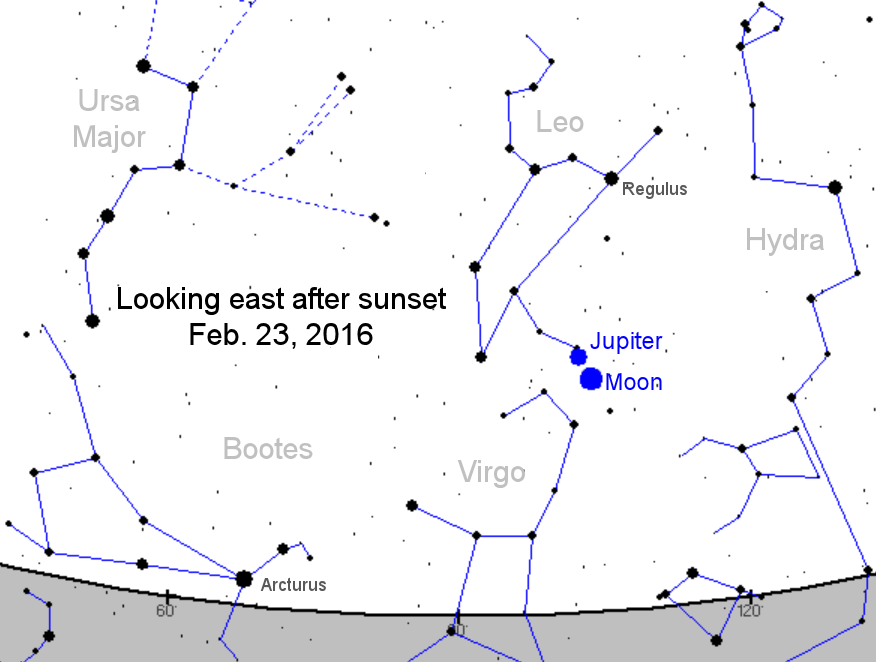
Awake at midnight? Go outside and look southeast. The Moon and Jupiter are having a bright conjunction in the constellation Ophiuchus, only a few degrees apart. Enjoy the show!
Sky maps: May 19, 20. www.spaceweather.com
0 Comments
On Oct. 26th, Venus will pass almost directly between Earth and the sun--an event astronomers call "inferior solar conjunction." As Venus approaches the sun, the planet is turning its night side toward Earth, reducing its luminous glow to a thin sliver. Shahrin Ahmad of Kuala Lumpur, Malaysia, took this picture on Oct. 20th: "I took this picture in broad daylight," says Ahmad. "Venus was really big in the eyepiece of my telescope--almost a full arcminute in diameter. And the crescent shape easily visible in the 8x50 finder scope."
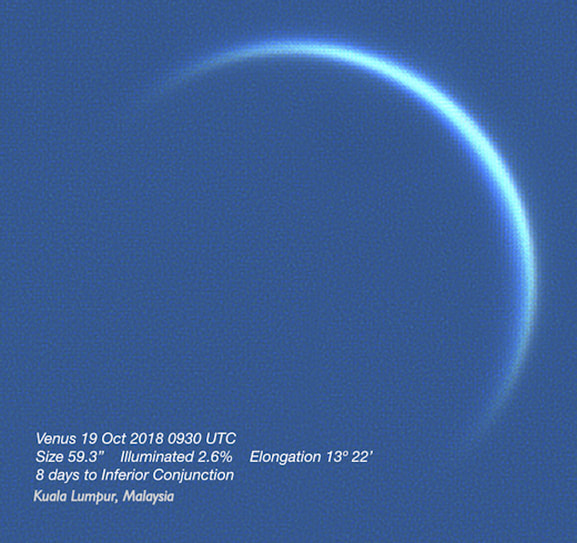
In the days ahead, the crescent of Venus will become increasingly thin and circular. The horns of the crescent might actually touch when the Venus-sun angle is least (~6 degrees) on Oct. 26th. This is arguably the most beautiful time to observe Venus, but also the most perilous. The glare of the nearby sun magnified by a telescope can damage the eyes of anyone looking through the eyepiece. Anthony J. Cook of the Griffith Observatory has some advice for observers: "I have observed Venus at conjunction, but only from within the shadow of a building, or by adding a mask to the front end of the telescope to fully shadow the optics from direct sunlight. This is tricky with a refractor or a catadioptric, because the optics start at the front end of the tube. Here at Griffith Observatory, I rotate the telescope dome to make sure the lens of the telescope is shaded from direct sunlight, even through it means that the lens will be partially blocked when aimed at Venus. With our Newtonian telescope, I add a curved cardboard mask at the front end of the tube to shadow the primary mirror." For the rest of this week Venus can still be observed without elaborate precautions in deep twilight after sunset. Every evening the crescent grows and narrows. Scan the realtime photo gallery for updates. www.spaceweather.com
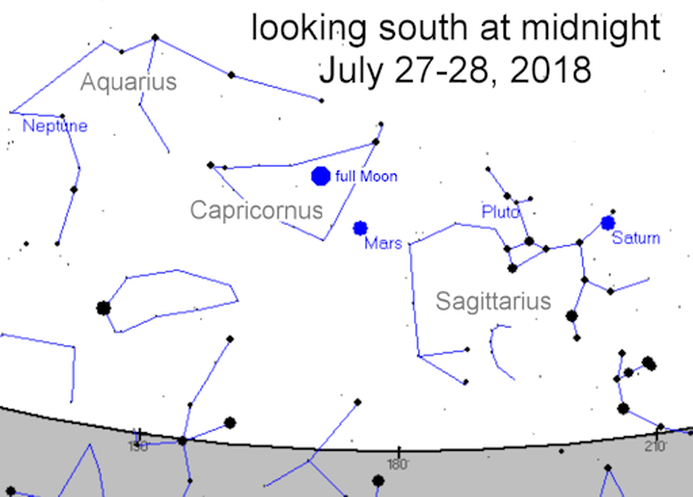
Tonight's the night. The Moon and Mars are converging for a midnight conjunction in the constellation Capricornus. This is no ordinary meeting of heavenly bodies. Mars is making a 15-year close approach to Earth, giving the Red Planet a luminosity that pierces the glare of the full Moon with ease.
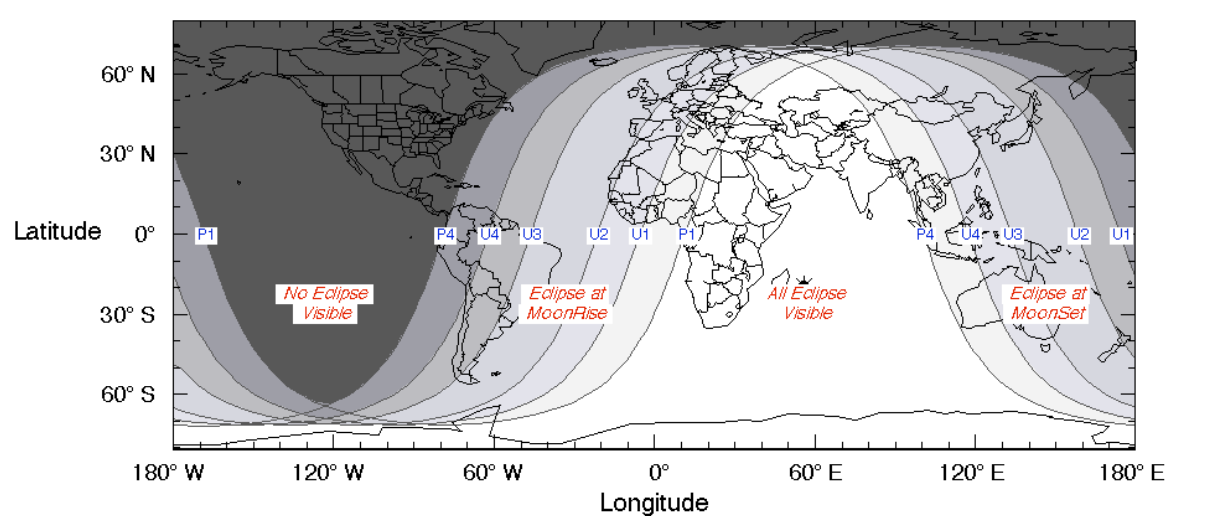
During the conjunction, something strange and wonderful will happen to the Moon. It is going to pass through the shadow of our planet, turning the lunar disk as red as Mars. Astronomers call this a "total lunar eclipse." On every continent except North America, people can see Earth's shadow swallow the Moon for as much as 1 hour 43 minutes, making it the longest lunar eclipse in a century. [eclipse visibility map]
This animation, created by graphic artist Larry Koehn, shows how the eclipse will unfold:
Got a backyard telescope? Tonight is a good time to use it. Swing your optics between the Moon and Mars in quick succession to reveal the dusty-red martian disk alongside lunar mountains and craters. It's a special night. Enjoy the show!
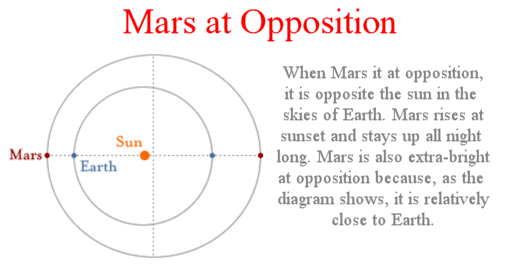
Live webcasts: from Israel, from Belgium. www.spaceweather.com Friday, July 27th, is a big night for astronomy. First, Mars will be at opposition--directly opposite the sun and making a 15-year close approach to Earth. Second, Mars and the Moon will be in conjunction--less than 10 degrees apart. Third, the Moon will pass through the shadow of Earth, producing the longest lunar eclipse in a century--visible everywhere except North America. What a night! Tune into live webcasts from Israel and Belgium.
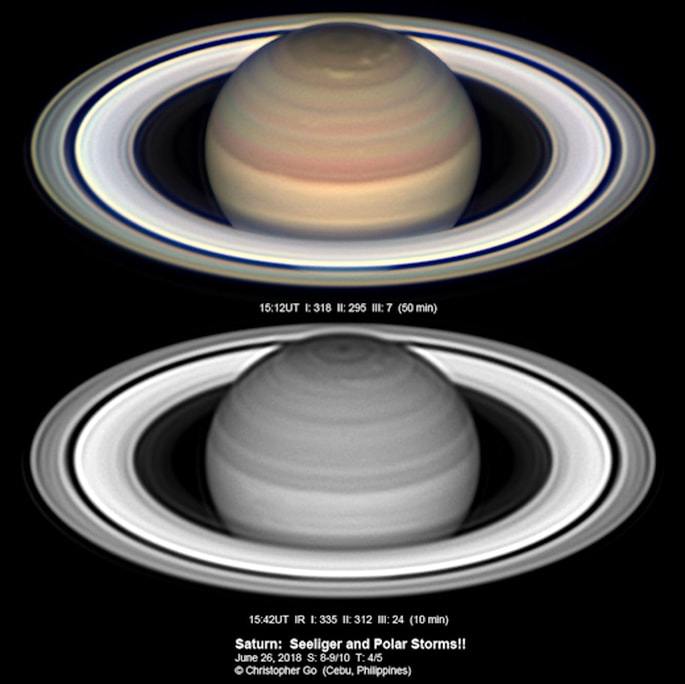
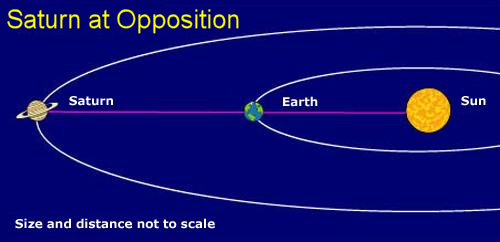
www.spaceweather.com Get out your telescope. Tonight Saturn is "at opposition"--that is, at its closest and brightest for all of 2018. To find the ringed planet, just look due south at midnight. It is easy to see with the unaided eye right beside the full Strawberry Moon in the constellation Sagittarius. [sky map] Even a small telescope will reveal Saturn's magnificent rings. Christopher Go sends this picture taken last night from Cebu City in the Philippines: "Saturn's rings are surging in brightness," he reports. "Now is a great time to see them."
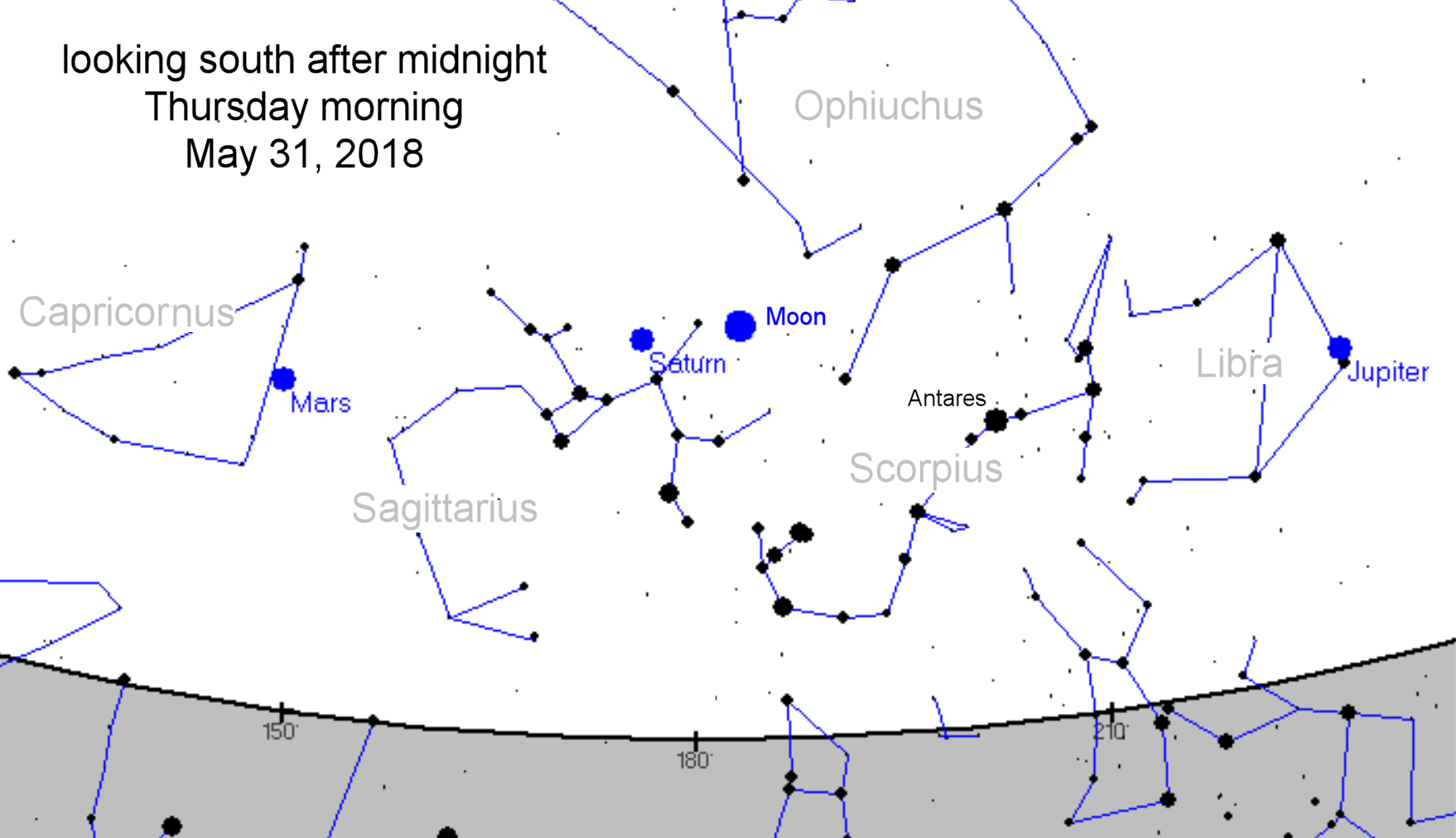
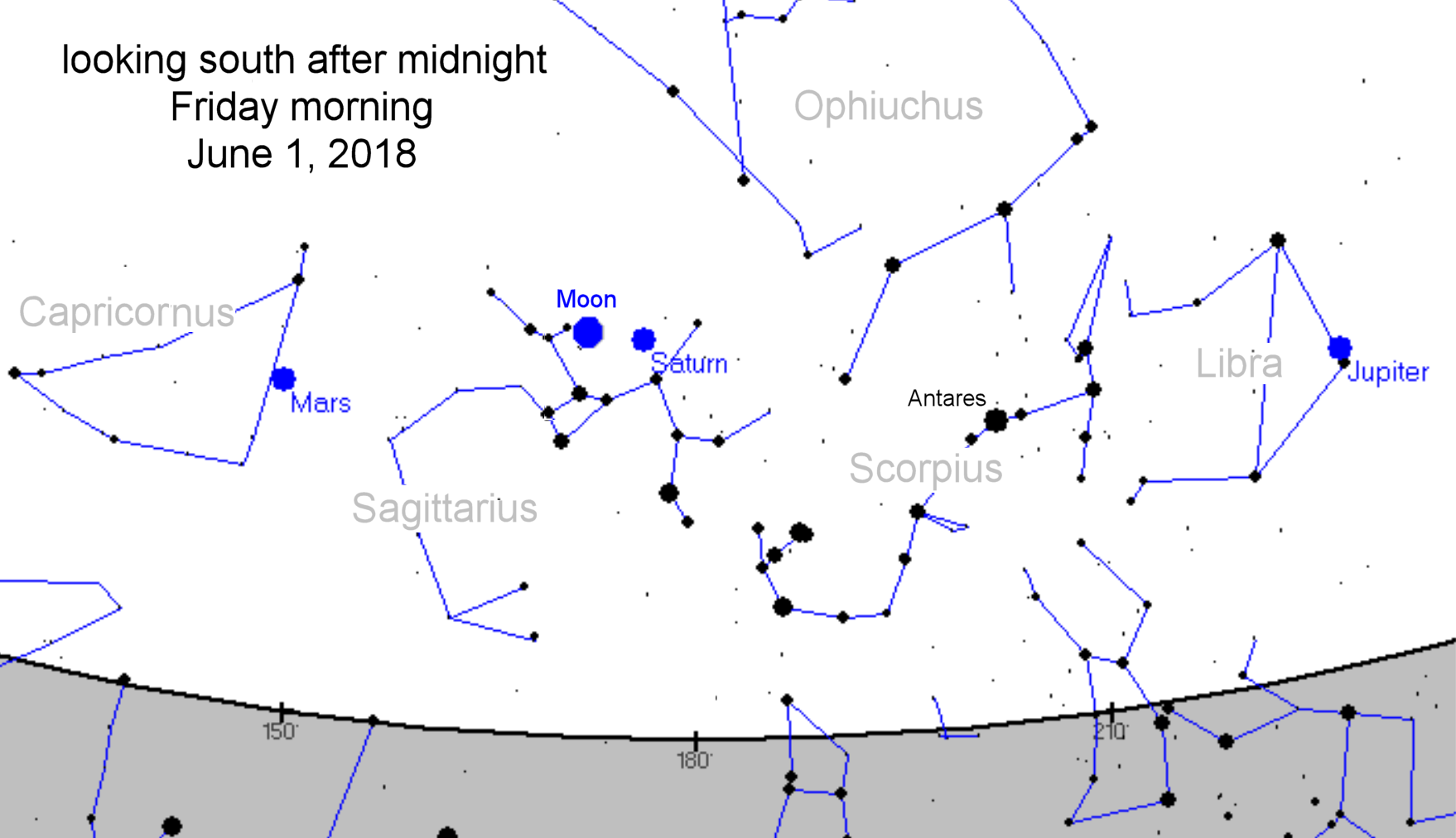
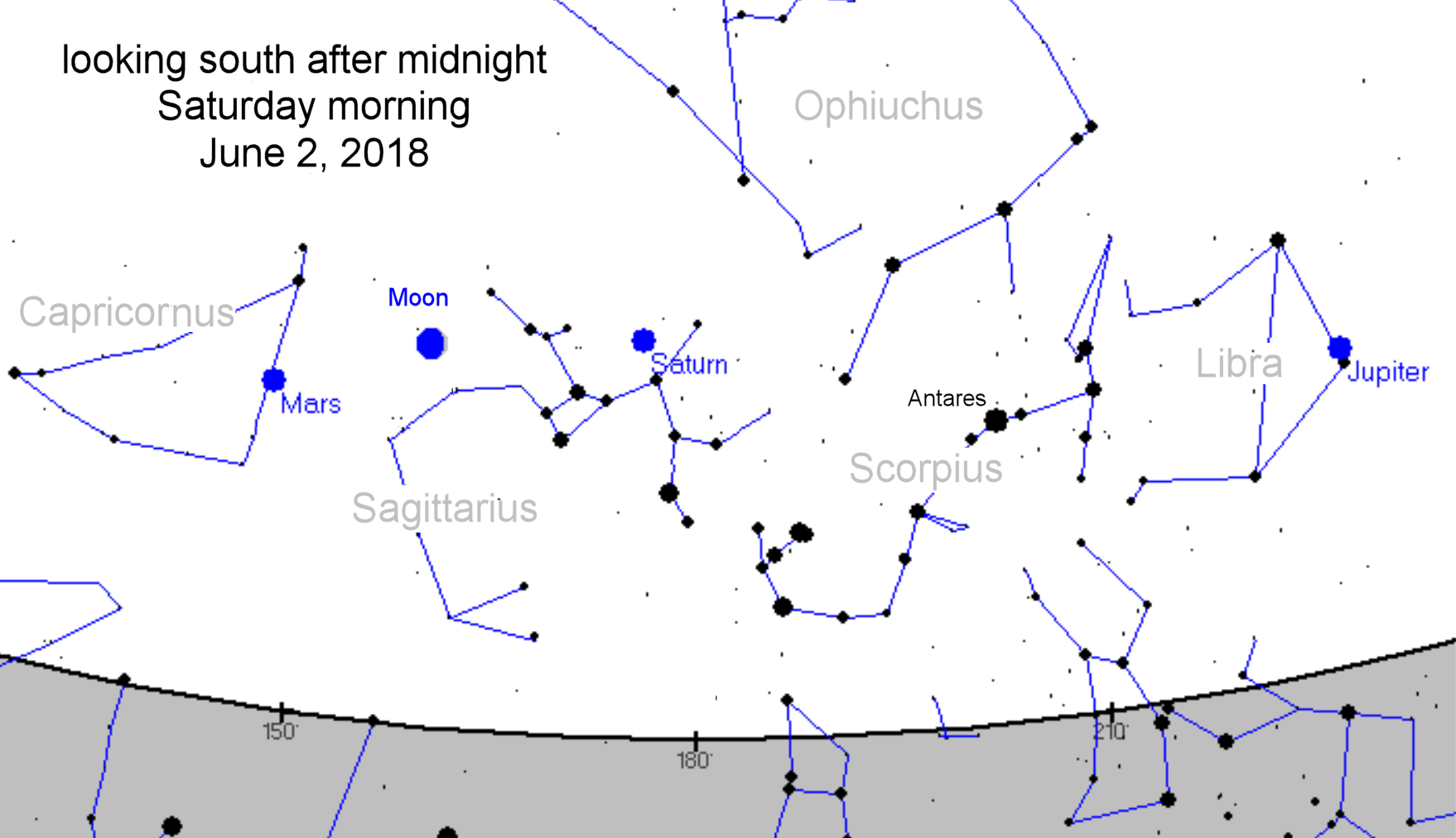
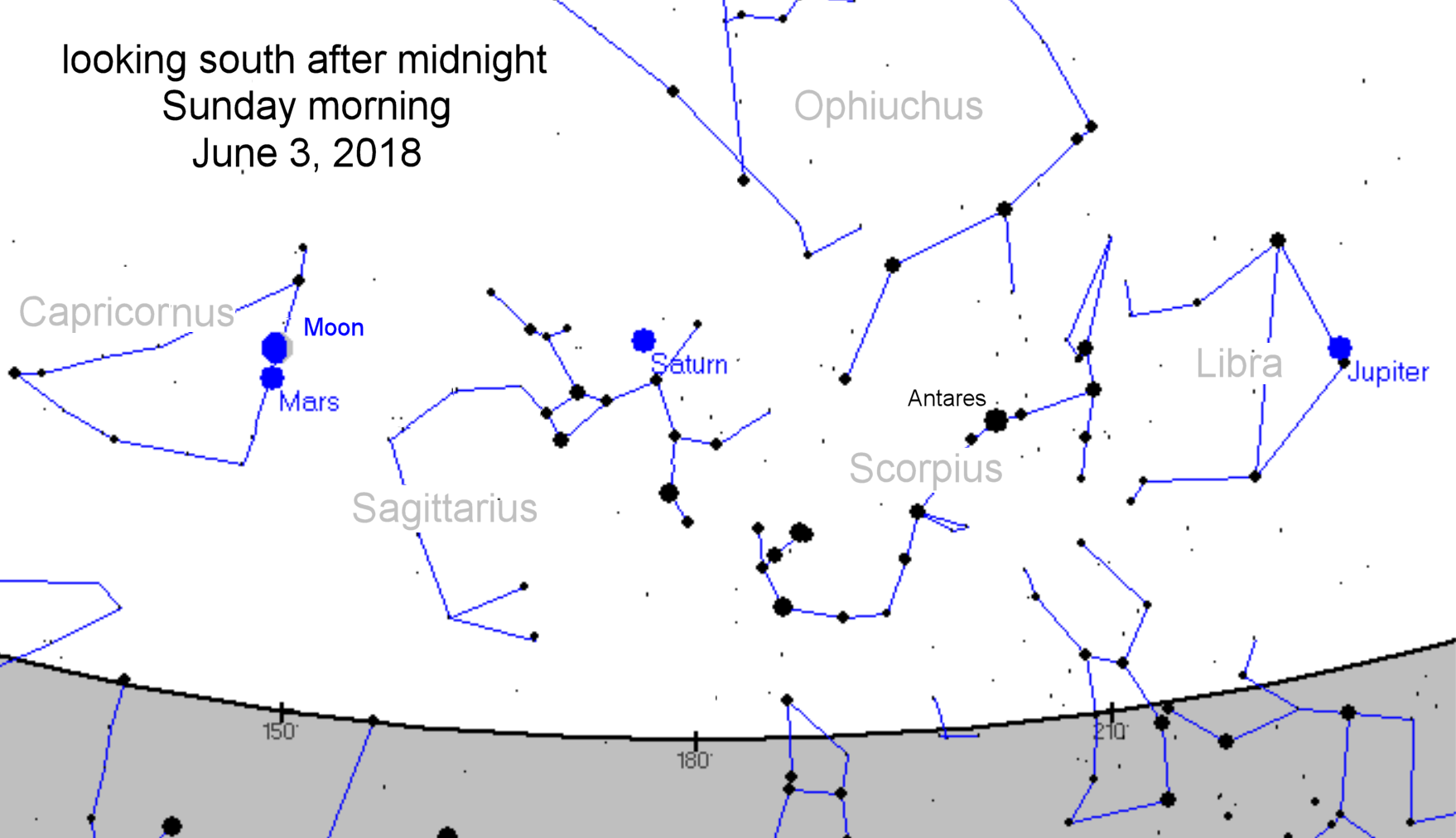
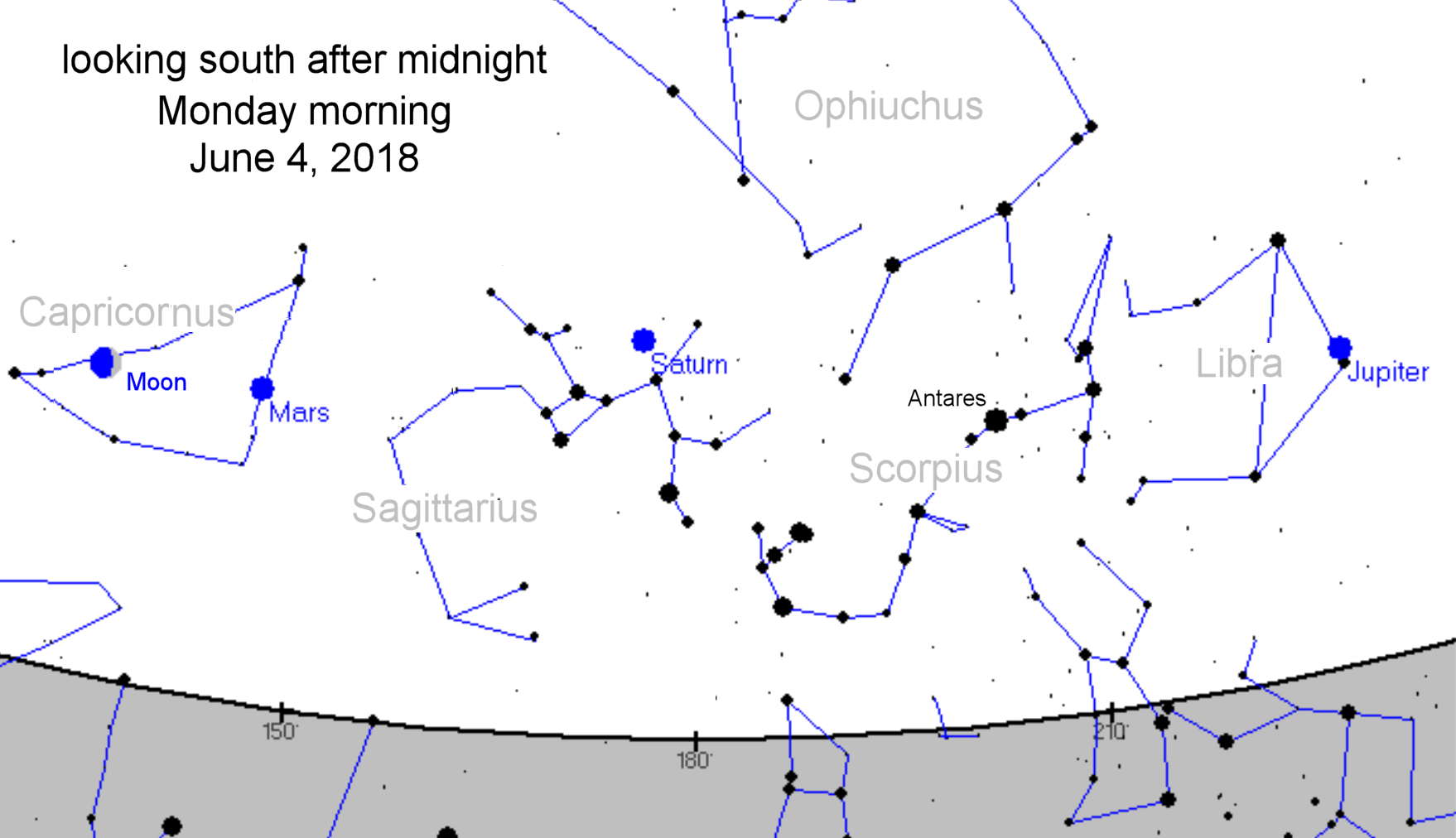
Saturn's rings are bright near opposition in part because the rings are closer than usual to Earth. They get an additional boost from "the Seeliger Effect," named after the German astronomer Hugo van Seeliger who first described it in the 19th century. It happens when sunlit objects such as the icy particles that make up Saturn's rings hide their own shadows. Opposition is the perfect time for the Seeliger effect because Saturn and the sun are on diametrically opposite sides of the sky. A process called coherent backscattering may also contribute to the extra luminosity. If you have a small telescope, tonight is a great time to use it. Point your optics at Saturn and enjoy the show. www.spaceweather.com Any night this week, step outside after midnight and look south. You'll see Jupiter, Saturn and Mars arranged in a bright line across the starry sky. The Moon can be your guide. It's hopping from one planet to the next with beautiful conjunctions on June 1st (Moon-Saturn) and especially June 3rd (Moon-Mars). Enjoy the show!
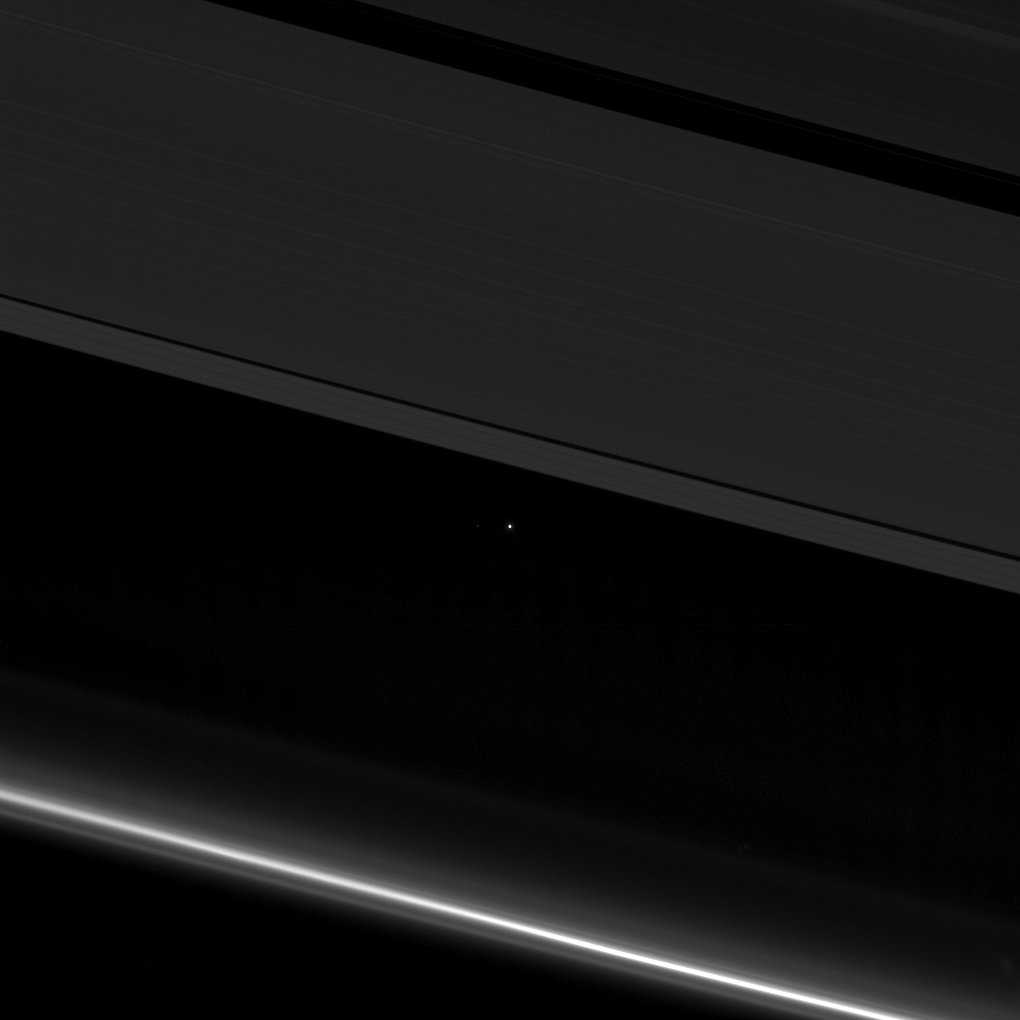
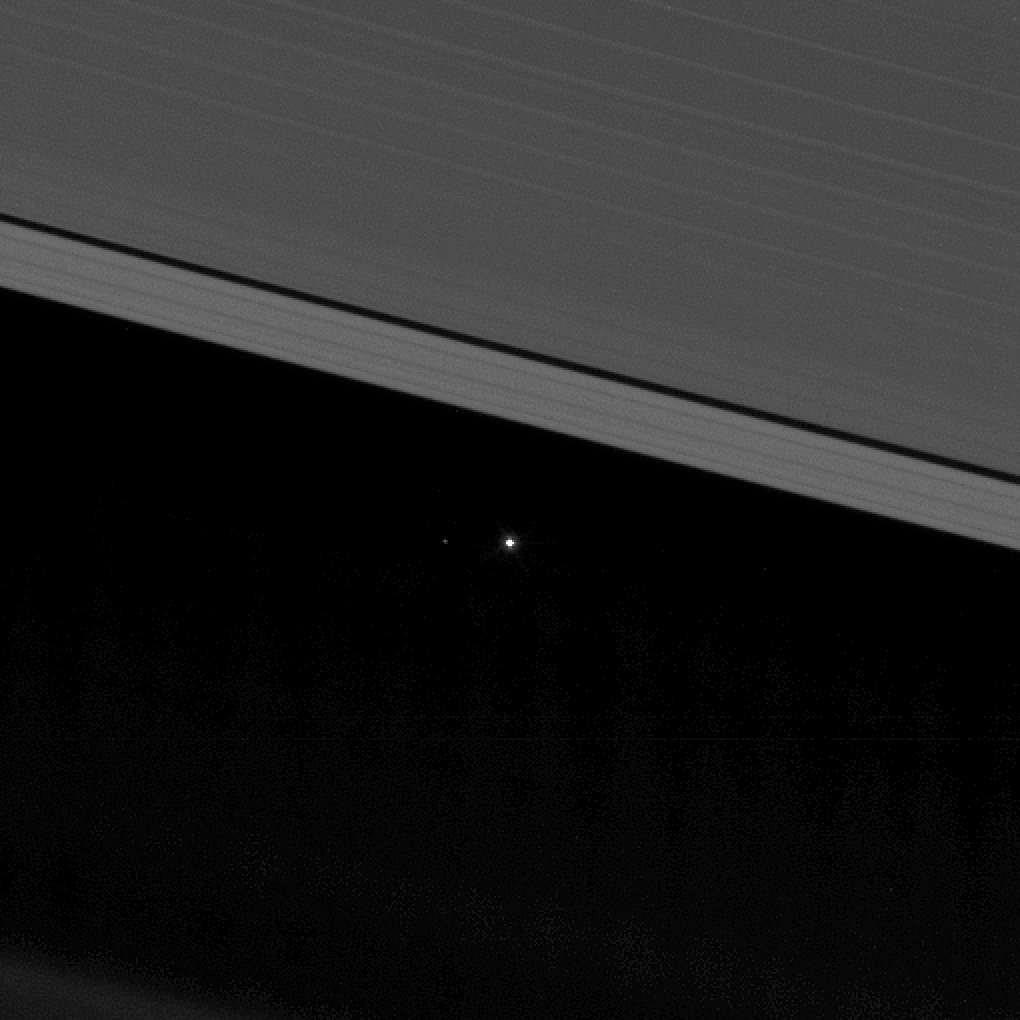
Sky maps: May 31, June 1, 2, 3, 4. www.spaceweather.com RT : 21 Apr 2017 NASA's Cassini spacecraft captured an incredible final image of Earth from 1.4 billion km away during its orbit of Saturn's rings. The space probe was facing Earth's Southern Atlantic Ocean, some 870 million miles (1.4 billion km) away, when the image of earth was captured on April 12, says NASA. CassiniSaturn ✔ @CassiniSaturn See that dot between #Saturn's rings? That's us. All of us, in Cassini's last view of Earth, a billion miles away. https://go.nasa.gov/2o9bZAe :11:18 PM - 20 Apr 2017 In a zoomed-in version of the image, Earth's moon is also clearly visible, seeming to float alongside our bright planet in the dark vastness of space. CassiniSaturn ✔ @CassiniSaturn Zoom into Cassini’s last view of Earth and you can also see the moon – a smaller, fainter dot to the left. https://go.nasa.gov/2o9bZAe :12:31 AM - 21 Apr 2017 The image marks Cassini's last view of Earth as the spacecraft prepares to end its mission by dramatically plunging into Saturn's atmosphere on September 15. The probe's 'Grand Finale' mission begins on Friday when the spacecraft will complete a close flyby of Saturn's moon, Titan - passing a mere 600 miles above its surface - before beginning its final set of 22 orbits between Saturn and its rings.
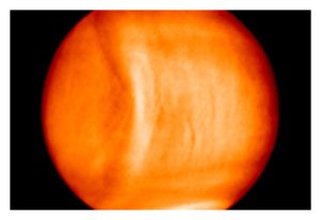
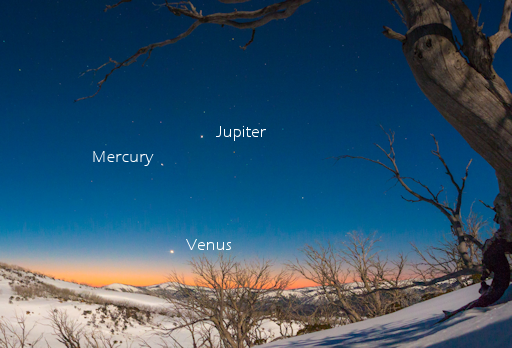
Cassini, a $3.2 billion mission from NASA, the European Space Agency (ESA) and the Italian Space Agency, launched in 1997 and has delivered unprecedented data of Saturn and its moons. You can see video from the mission here. Andrew Liptak : The Verge : 16 Jan 2017 The Japanese probe Akatsuki has observed a massive gravity wave in the atmosphere of Venus. This is not the first time such a wave was observed on the Solar System's second planet, but it is the largest ever recorded, stretching just over 6,000 miles from end to end. Its features also suggest that the dynamics of Venus' atmosphere are more complex than previously thought. An atmospheric gravity wave is a ripple in the density of a planet's atmosphere, according to the European Space Agency. (This isn't a gravitational wave, which is a ripple in space-time.) We have these waves in Earth's atmosphere, too; they interfere with weather and cause turbulence. Scientists have observed atmospheric gravity waves on Venus before: the European Space Agency's Venus Express spotted several before the end of its mission in 2014. Since its initial observations, Akatsuki has spotted several smaller structures with its infrared cameras in April and May 2016. Akatsuki spotted this particular gravity wave, described in a paper published today in Nature Geoscience, when the probe arrived at the planet on December 7th, 2015. The spacecraft then lost sight of it on December 12th, 2015, because of a change in Akatsuki's orbit. When the probe returned to a position to observe the bow-shaped structure on January 15th, 2016, the bright wave had vanished. What sets the huge December wave apart from previously discovered ones is that it appeared to be stationary above a mountainous region on the planet's surface, despite the background atmospheric winds. The study's authors believe that the bright structure is the result of a gravity wave that was formed in the lower atmosphere as it flowed over the planet's mountainous terrain. It's not clear how the wave exactly propagates to the planet's upper atmosphere, where clouds rotate faster than the planets itself — four days instead of the 243 days it takes Venus to rotate once. The massive gravity wave might mean that the atmospheric conditions closer to the planet's surface are more variable than predicted. Venus and Jupiter are converging in the sunset sky for a close encounter on Aug.27th. Yesterday in the Snowy Mountains of NSW Australia, Phil Hart photographed the two bright planets approaching one another with Mercury looking on: "A highlight of six days backcountry skiing in NSW was the planetary alignment of Venus, Mercury and Jupiter," says Hart. "It took a few nights to get the weather and scenery to cooperate, but after an hour of traipsing around and lying down in the snow, I managed to capture this shot on our last night out."
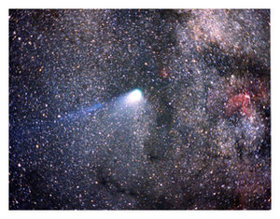
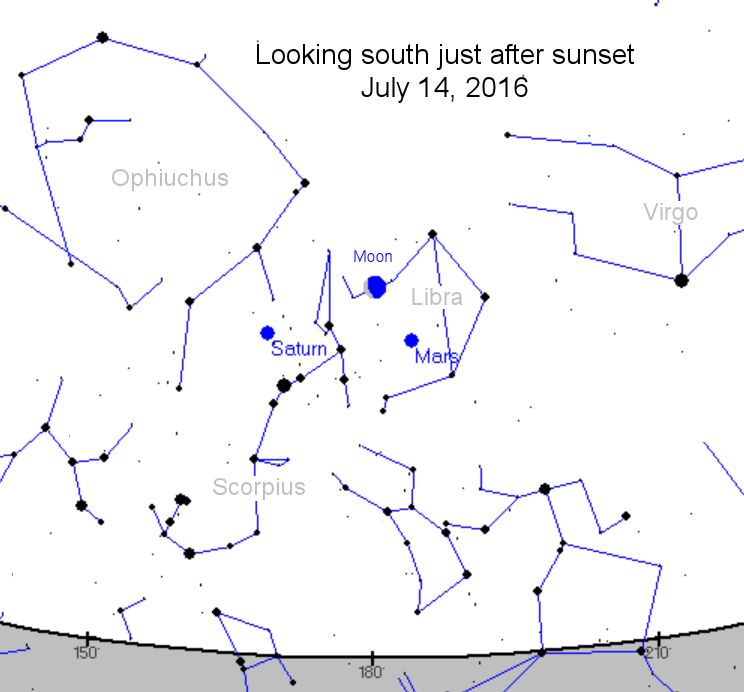
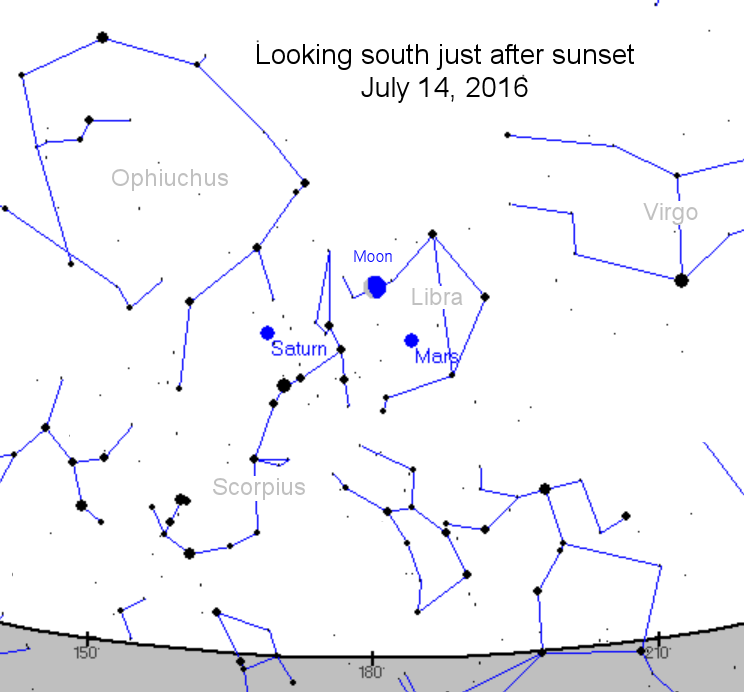
The view will improve in the evenings ahead as the distance between Jupiter and Venus decreases. At closest approach on Aug 27th, the two worlds will appear only about 1/15th of a degree apart. If you hold a pencil at arm's length, the eraser would cover both planets at once. Moreover, Venus and Jupiter will easily fit within a telescopic field of view--an amazing sight if you have a backyard telescope. Remember, though, that a telescope is not required. Venus and Jupiter are bright enough to see with the naked eye even from light-polluted urban areas. Try to catch them about 30 minutes after sunset before the sky fades completely black. The sight of two planets in conjunction surrounded by twilight blue is extra-beautiful. www.spaceweather.com Nola Taylor Redd : Discover Magazine : 22 Jul 2016 © NASA : Halley’s comet. If you're waiting for Halley's comet to show up exactly 75 years after its 1986 appearance, you may be disappointed. The ball of ice has an orbit that varies by months or even years. And new research suggests that Venus is responsible for the comet's variations today, rather than the more massive planet Jupiter. "Comet Halley has been observed throughout history, all the way back to 240 BC by the Chinese," Tjarda Boekholt, an astrophysicist at Leiden Observatory in the Netherlands, told Discover by email. Erratic Schedule With many well-documented appearances, scientists quickly realized that the arrival time of the comet was constantly changing. For instance, although it passed Earth in February in 1986, it won't be back until February 2061. In 45 years, it will instead appear in July. "It is the variation in the time of sightings that provided the first clue to comet Halley's chaotic orbit," Boekholt said. "The orbit of comet Halley is not static, but it is evolving." Boekholt led a team that investigated the comet's changing orbit. They found that Venus played an important role in revising the comet's orbit in the past, and will probably continue to do so in the future, despite its small stature. Mighty Jupiter often dominates the influence of gravitational bodies due to its high mass, but Venus currently dominates Halley's movements. Narrowing down how and why Halley's orbit changes can help improve scientists' understanding of how other bodies move in the solar system. "Performing such analysis to other bodies in the solar system, we can obtain a better overview and understanding of chaotic orbits, stable orbits, and the dynamical evolution of the solar system and other planetary systems," says Boekholt. This is an extract; the whole story, with video, can be found here. When the sun goes down tonight, step outside and look up. There's a celestial triangle in the southern sky: the waxing full Moon, red Mars, and golden Saturn. Try to catch them before the sky fades completely black. The Moon and planets surrounded by twilight blue look extra-beautiful. [sky map]
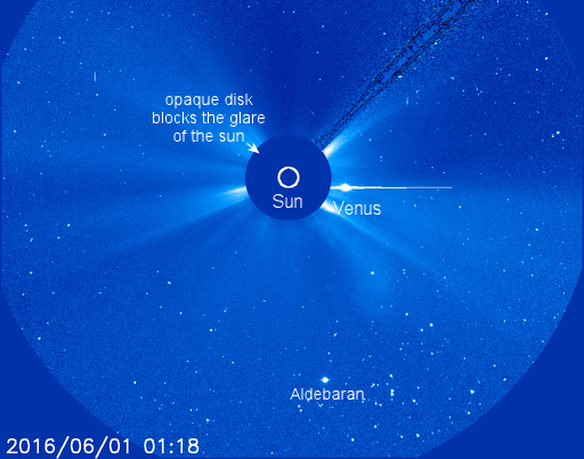
Venus is about to pass directly behind the sun, an event astronomers call "superior conjunction." Coronagraphs onboard the Solar and Heliospheric Observatory (SOHO) are monitoring Venus as it disappears into the glare: On June 7th, Venus will be at superior conjunction--a wonderful sight if only we could see it.
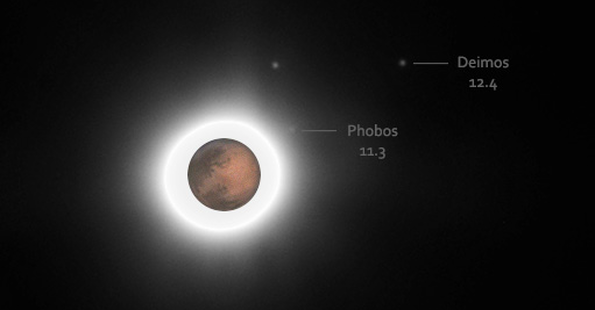
Like the Moon, Venus has phases and on June 7th it will be gloriously full. The entire hemisphere facing Earth will be illuminated. Venus's acid-laced clouds are terrific reflectors and a full Venus would surely be visible in broad daylight, an intense pinprick of light in the blue sky. Venus's passage behind the sun marks an important transition. Earlier this year, Venus was a "morning star." After it emerges from behind the sun, it will become an "evening star" later in June. www.spaceweather.com The moons of Mars are so small, some astronomers believe they are captured asteroids. Named Phobos and Deimos (Fear and Dread), the diminutive satellites average 17 km in diameter and are rarely seen in pictures of the Red Planet. On May 24th, astrophotographer Dennis Simmons of Brisbane, Australia, attempted to capture both. Rate of success: 100%. Mars shines 242,000 times brighter than Phobos and 741,000 times brighter than Deimos. The two moons are easily lost in the glare. "Deimos was relatively easy, but Phobos had to be gently teased out of the data," says Simmons, who used a 9 inch Celestron telescope.
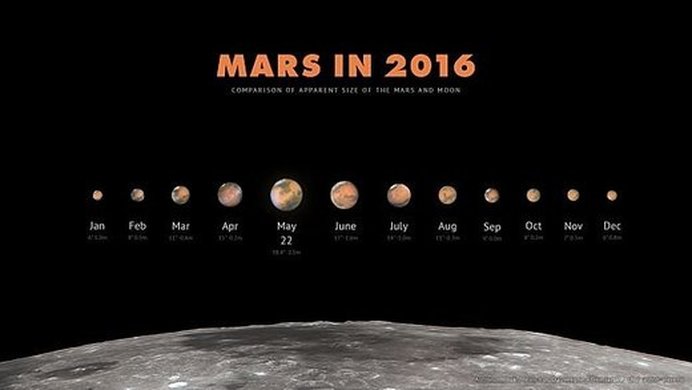
This is a good time for astrophotographers to seek Fear and Dread. Why? Because Mars is unusually close to Earth. On May 30th, the two planets will be only 47 million miles apart--the closest they've been since 2005. This proximity not only boosts the apparent brightness of the tiny moons, but also increases their angular separation from Mars. Browse the gallery for sightings. www.spaceweather.com Brian Lada : Accuweather : 18 May 2016 Astronomers and stargazers are in for a treat this upcoming weekend with two big celestial events taking place; a full 'Blue Moon' and the opposition of Mars. Blue Moon May's Full Moon goes by several names, including the Full Flower Moon, the Full Corn Planting Moon and the Milk Moon. But this year, it will also go by the title of a Blue Moon. A Blue Moon typically occurs once every few years (hence the term 'once in a Blue Moon') and is commonly the name of the second full moon in a calendar month. However, this weekend's Blue Moon gained its name a different way. Normally, there are only three full moons in each season, but occasionally there is a season with four full moons. When this happens, like this spring, the third of the four full moons earns the name of a Blue Moon. Despite their name, blue moons are not actually the color blue and will appear their typical color. The next 'traditional' Blue Moon does not occur until January 31, 2018. Mars Opposition One day after the full moon, Mars will reach opposition, meaning that that Earth will be passing directly between Mars and the sun. When this happens, Mars will be extremely bright, making it a great time for astronomers to observe the planet. © EarthSky/Mikhail Chubarets Mars will be one of the brightest objects in the sky on Sunday night after the Moon and will be visible from dusk to dawn.
According to EarthSky, by the time Mars reaches opposition, it will have quadrupled in brightness since the beginning of April. Additionally, it will shine nearly 80 times brighter than it does when the planet is at its faintest. Even if clouds block your view of Mars on Sunday night, it should remain bright for several weeks before it slowly and steadily becomes faint. About a week after opposition, Mars will make its closest approach to Earth in over 10 years. At a distance of 46.8 million miles (75.3 million km), this will be the closest the Red Planet has been to our planet since 2003! Although this is the closest the planets have been in years, it does not mean that Mars will be significantly larger in the night sky as some social media hoaxes might suggest. While it is true that Mars does give off a red glow in the night sky, you will not be able to see the planet like you would the Moon On March 8th, Earth and Jupiter will have a close encounter. The giant planet will be "up all night," soaring almost overhead at midnight and not setting until the sky brightens with the twilight hues of sunrise on March 9th. Get the full story from Science@NASA.
www.spaceweather.com |
QUICK INFO
Author:
_Messenger Spirit This section is for interesting items which are brought to my attention but which do not merit a separate article.
I welcome your comments, questions or suggestions on any topics you wish to contribute to this section. Please submit these on the Contact and Feedback Form PLEASE DO NOT SUBMIT COMMENTS ON THE FORM WHICH APPEARS UNDER ITEMS ON 'QUICK INFO'; THIS SYSTEM IS NOT WORKING. Categories
All
Archives
June 2026
|