Look at the CME movie one more time. The speckles near the end are caused by energetic protons accelerated by the flare. Guided toward Earth by solar magnetic fields, the protons are peppering Earth-orbiting satellites, causing "snow" in imaging systems and posing a slim threat for single-event upsets (computer glitches).
|
For days, giant sunspot AR1515 has looked capable of producing a really strong explosion. On July 6th it finally did. Yesterday, the sunspot's magnetic canopy erupted, producing a brief but potent X1.1-class solar flare. NASA's Solar Dynamics Observatory recorded the extreme ultraviolet flash: [go to: www.spaceweather.com] The explosion hurled a CME into space. According to this movie from the Solar and Heliospheric Observatory, the cloud appears to be heading south and away from Earth. However, we cannot yet rule out a glancing blow to our planet on July 8th or 9th. Stay tuned for further analysis. Look at the CME movie one more time. The speckles near the end are caused by energetic protons accelerated by the flare. Guided toward Earth by solar magnetic fields, the protons are peppering Earth-orbiting satellites, causing "snow" in imaging systems and posing a slim threat for single-event upsets (computer glitches).
0 Comments
CERN physicists announce they are 99% certain they have found elusive Higgs boson particle Physicists say they have discovered a new particle that is consistent with the Higgs boson, a long-sought particle crucial to scientists’ current understanding of how the universe is built, although they will need additional data to pin it down with near absolute certainty. Joe Incandela, leader of one of the teams, told scientists at the European Center for Nuclear Research, or CERN, that the new particle was definitely a boson and the heaviest boson ever found. “The implications are very significant and it is precisely for this reason that we must be extremely diligent in all of our studies and cross-checks.” he said in a statement. The new particle found at CERN is in the mass range of 125-126 GeV, or gigaelectronvolts, which means its mass is 125-126 times greater than the mass of a proton. CERN said their data had pinned down the mass of the new particle with an extremely high level of statistical certainty. "It’s hard not to get excited by these results.” said CERN Research Director Sergio. However, the researchers cautioned that the current finding was still preliminary and they expect more data from additional experiments in coming months. One crucial detail would be for them to pin down specific properties that the Higgs boson is supposed to have. For example, the theory predicts it will have a spin of zero. –WSJ Uploaded by fermilab on 7 Jul 2011 Fermilab scientist Don Lincoln describes the nature of the Higgs boson. Several large experimental groups are hot on the trail of this elusive subatomic particle which is thought to explain the origins of particle mass. [It is very interesting to watch scientists attempting to discover smaller and smaller particles, including the so-called 'God particle', but they will never be able to reach the 'infinitely small', to which there is no end (infinity includes the infinitely small as well as the infinitely large). Perhaps a better emphasis would be on the contemplation of who or what actually CREATES the Field within which the physical creation exists .... However, it does seem that Science and Spirituality are slowly drawing closer to each other. Messenger Spirit]
For nearly 35 years, NASA’s Voyager 1 probe has been hurtling toward the edge of the solar system, flying through the dark void on a mission unlike anything attempted before. One day, mission controllers hope, Voyager 1 will leave the solar system behind and enter the realm of the stars—interstellar space. That day may be upon us. At the edge of the solar system, Voyager 1 is reporting a sharp increase in cosmic rays that could herald the spacecraft's long-awaited breakthrough into interstellar space. "The latest data from Voyager 1 indicate that we are clearly in a new region where things are changing quickly," says Ed Stone, Voyager project scientist at the California Institute of Technology in Pasadena. This is very exciting. We are approaching the solar system's final frontier." The “frontier” he’s referring to is the edge of the heliosphere, a great magnetic bubble that surrounds the sun and planets. The heliosphere is the sun’s own magnetic field inflated to gargantuan proportions by the solar wind. Inside lies the solar system - “home.” Outside lies interstellar space, where no spacecraft has gone before.
A telltale sign of the frontier’s approach is the number of cosmic rays hitting Voyager 1. Cosmic rays are high energy particles such as protons and helium nuclei accelerated to near-light speed by distant supernovas and black holes. The heliosphere protects the solar system from these subatomic bullets, deflecting and slowing many of them before they can reach the inner planets. As Voyager approaches the frontier, the number of cosmic rays has gone up. More at - http://science.nasa.gov/science-news/science-at-nasa/2012/21jun_finalfrontier/ So much for the decay of sunspot AR1429. The active region unleashed another strong flare on March 13th, an M7-class eruption that peaked around 1741 UT. A first-look image from NASA's Solar Dynamics Observatory show's the flare's extreme ultraviolet flash. The blast accelerated energetic protons toward Earth and a solar radiation storm is now developing around our planet. Stay tuned for updates.
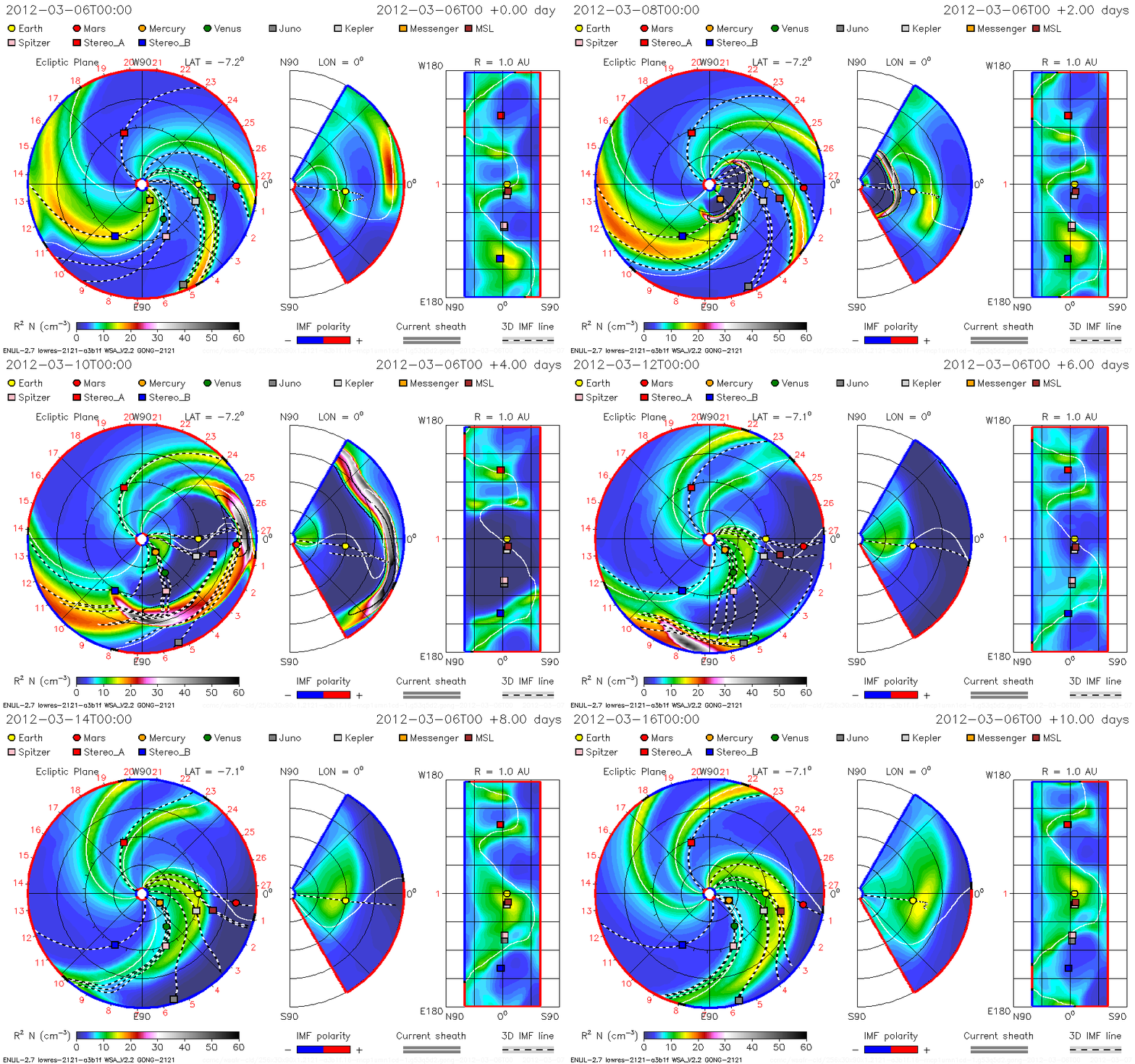
UPDATE: Analysts at the Goddard Space Weather Lab estimate that the CME will reach Earth on March 8th at 0625 UT (+/- 7 hr), possibly triggering a strong-to-extreme geomagnetic storm. An animated forecast track shows the progression of the fast-moving cloud. The flare also accelerated energetic protons toward Earth, triggering an S3-class solar radiation storm, in progress. Such a storm is mainly a nuisance to satellites, causing occasional reboots of onboard computers and adding noise to imaging systems. www.spaceweather.com _CME IMPACT: As expected, a CME hit Earth's magnetic field on Jan. 24th at approximately 1500 UT (10 am EST). Geomagnetic storms are likely in the hours ahead. If it's dark where you live, go outside and look for auroras. __ In Lofoton, Norway, the CME's arrival produced a surge in ground currents outside the laboratory of Rob Stammes: "The expected CME arrived and showed up on my instruments at 15.10 UTC--a fantastic shockwave followed by a magnetic storm," says Stammes. "This could be a happy day for many aurora watchers." http://spaceweather.com/ Information: Proton Flux The sun is a big mass of energy. The sun produces high energy protons, and the solar wind carries these protons towards our planet. During solar flare activity, energetic protons are blown violently outwards... sometimes towards earth. Energetic protons can reach Earth within 30 minutes of a major flare's peak. During such an event (big ones are also known as Solar Proton Events), Earth is showered with highly energetic solar particles (primarily protons) released from the flare site. When these protons arrive at Earth and enter the atmosphere over the polar regions, much enhanced ionization is produced at altitudes below 100 km. Ionization at these low altitudes is particularly effective in absorbing HF radio signals and can render HF communications impossible throughout the polar regions. This effect is called Radio Blackouts. This type of event is also known as a Polar Cap Absorption Event or PCA. http://www.solarham.com/proton.html Strongest Radiation Storm since 2003 The solar proton flux continues at high levels. After the CME impacted Earth this morning, it reached even higher (6300 pfu) and is now the largest radiation storm since October 2003. A Strong S3 Level radiation storm remains in progress. http://www.solarham.com/proton.htm |
QUICK INFO
Author:
_Messenger Spirit This section is for interesting items which are brought to my attention but which do not merit a separate article.
I welcome your comments, questions or suggestions on any topics you wish to contribute to this section. Please submit these on the Contact and Feedback Form PLEASE DO NOT SUBMIT COMMENTS ON THE FORM WHICH APPEARS UNDER ITEMS ON 'QUICK INFO'; THIS SYSTEM IS NOT WORKING. Categories
All
Archives
October 2026
|


RSS Feed