Mark your calendar: The annual Geminid meteor shower, caused by rock comet 3200 Phaethon, peaks this year on Dec. 14th. On that date, dark-sky observers around the world could see as many as 120 meteors per hour. As November comes to a close, Earth is entering the outskirts of 3200 Phaethon's debris stream, causing a slow drizzle of meteors weeks ahead of peak night. The first Geminid fireball of the season was detected over the USA on Nov. 26th by NASA's network of all-sky meteor cameras. www.spaceweather.com
|
Ian O'Neill : ABC Science, Australia : 12 Nov 2014 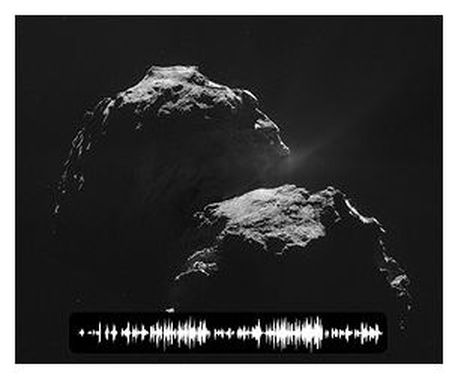 © ESA/Rosetta/NavCam Through some kind of interaction in the comet's environment, 67P's weak magnetic field seems to be oscillating at low frequencies. The Rosetta mission has detected a mysterious signal coming from Comet 67P/Churyumov-Gerasimenko. The mission has five instruments in the Rosetta Plasma Consortium (RPC) that measure the plasma environment surrounding the comet.
Plasma is a charged gas and the RPC is tasked with understanding variations in the comet's activity, how 67P's jets of vapour and dust interacts with the solar wind and the dynamic structure of the comet's nucleus and coma. But when recording signals in the 40-50 millihertz frequency range, the RPC scientists stumbled on a surprise - the comet was singing, they report. Through some kind of interaction in the comet's environment, 67P's weak magnetic field seems to be oscillating at low frequencies. In an effort to better understand this unique 'song', mission scientists have increased the frequency 10,000 times to make it audible to the human ear. First detected in August as Rosetta approached the comet from 100 kilometres, this magnetic oscillation has continued. Rosetta scientists speculate that the oscillations may be driven by the ionisation of neutral particles from the comet's jets. As they are released into space, they collide with high-energy particles from interplanetary space and become ionised. Because it is electrically charged, the plasma then interacts with the cometary magnetic field, causing oscillations. But to draw any conclusions about this, further work is needed. Source: Discovery News To read the rest of this article and hear the sound of the 'singing comet' go to : http://www.sott.net/article/288829-Rosettas-comet-sings-a-mysterious-song Frank Jordans : The Associated Press : 12 Nov 2014 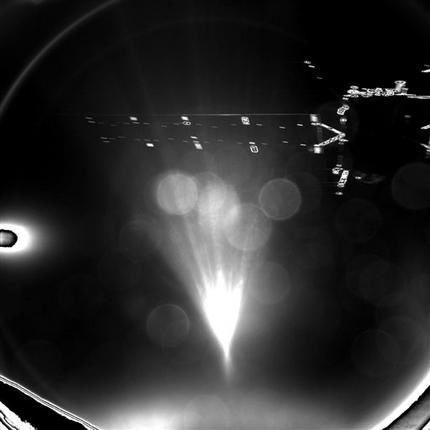
© AP Photo/ESA The picture released by the European Space Agency ESA on Wednesday, Nov. 12, 2014 was taken by Rosetta's lander Philae shortly after its separation from the mother spaceship with the lander’s CIVA-P imaging system and captures one of Rosetta's 14 metre-long solar wings. On Wednesday, Nov. 12, 2014 the Philae lander detached from Rosetta and started it's descent to the 4-kilometer-wide (2.5-mile-wide) 67P/Churyumov-Gerasimenko comet. The European Space Agency celebrated a cosmic touchdown Wednesday by successfully landing a spacecraft on a comet for the first time in history. The agency said it has received a signal at 1603 GMT (11:03 a.m. EST) from the 100-kilogram (220-pound) Philae lander after it touched down on the icy surface of the comet named 67P/Churyumov-Gerasimenko. "We definitely confirm that the lander is on the surface," said flight director Andrea Accomazzo.
While further checks are needed to ascertain the state of the lander, the fact that it is resting on the surface of the speeding comet is already a huge success. It marks the highlight of the decade-long Rosetta mission to study comets and learn more about the origins of these celestial bodies. The head of the European Space Agency underlined Europe's pride in having achieved a unique first ahead of its U.S. counterpart NASA. "We are the first to have done that, and that will stay forever," said ESA director-general Jean-Jacques Dordain. The landing caps a 6.4 billion-kilometer (4 billion-mile) journey begun a decade ago. Rosetta, which was launched in 2004, had to slingshot three times around Earth and once around Mars before it could work up enough speed to chase down the comet, which it reached in August. Rosetta and the comet have been traveling in tandem ever since at 41,000 mph (66,000 kph). The mission will also give researchers the opportunity to test the theory that comets brought organic matter and water to Earth billions of years ago, said Klim Churyumov, one of the two astronomers who discovered the comet in 1969. http://www.sott.net/article/288851-European-spacecraft-lands-on-comet No spacecraft has ever landed on a comet--until today. On Wednesday, Nov. 12th, the European Space Agency dropped a lander onto the strangely-shaped core of Comet 67P. Get the full story directly from the ESA.
www.spaceweather.com The European Space Agency is about to make history: On Nov. 12th, it is going to land on a comet. The action begins Wednesday at 08:35 UT when ESA's Rosetta spacecraft drops a probe named "Philae" onto the core of Comet 67P. This video shows what happens next: In the past, nations of Earth have landed on planets, moons, and asteroids, but never before on a comet. This is an important and daring first. "A comet is unlike any other planetary body that we've attempted to land on," says Claudia Alexander of the US Rosetta Project at JPL. "Getting Philae down successfully will be an incredible achievement for humankind."
"How hard is this landing?" asks Art Chmielewski, the US Rosetta Project Manager. "Consider this: the comet will be moving 40 times faster than a speeding bullet, spinning, shooting out gas and welcoming Rosetta on the surface with boulders, cracks, scarps and possibly meters of dust!" Philae will take 7 hours to fall 22.5 km from the spacecraft to the comet--an interval some mission scientists are calling "The Seven Hours of Terror." Confirmation of the landing will reach ground stations on Wednesday at approximately 1600 UT. You can follow the descent as it happens by tuning in to ESA's #CometLanding webcast. www.spaceweather.com Amanda Barnett, Ben Brumfield and Mariano Castillo : CNN : 20 Oct 2014
The comet came so close that Mars Odyssey, Mars Reconnaissance Orbiter and the Mars Atmosphere and Volatile Evolution (MAVEN) had to duck and cover on the other side of the planet. Otherwise, Siding Spring's debris of dust and gas flying at 126,000 miles per hour just 87,000 miles above Mars' surface could have blasted them like a shotgun. They're all OK, NASA said in a statement. It will take a few days for them to transfer pictures and data to Earth. Siding Spring has moved on. The comet does not pose a threat to Earth and was headed back out to the outer reaches of the solar system, NASA said. Comet spectators The Mars Reconnaissance Orbiter was the first of the spacecraft to report it was unharmed as the comet passed. It made observations of the comet before sheltering behind Mars, NASA said. "The spacecraft performed flawlessly throughout the comet flyby," said Mars Reconnaissance Orbiter Project Manager Dan Johnston of NASA's Jet Propulsion Laboratory. "It maneuvered for the planned observations of the comet and emerged unscathed." The Mars Reconnaissance Orbiter immediately began to transmit information to Earth, but the full downlink could take days, NASA said. Several Earth-based and space telescopes, including the Hubble Space Telescope, also took pictures. The NASA rovers that are on the surface of Mars were protected by Mars' atmosphere, NASA said. They watched Siding Spring much like a spectator would watch a comet flyby here on Earth. http://www.sott.net/article/287644-Comet-Siding-Spring-shaved-past-Mars-but-NASA-orbiters-and-rovers-are-safe 10.19.2014 : Source: Jet Propulsion Laboratory 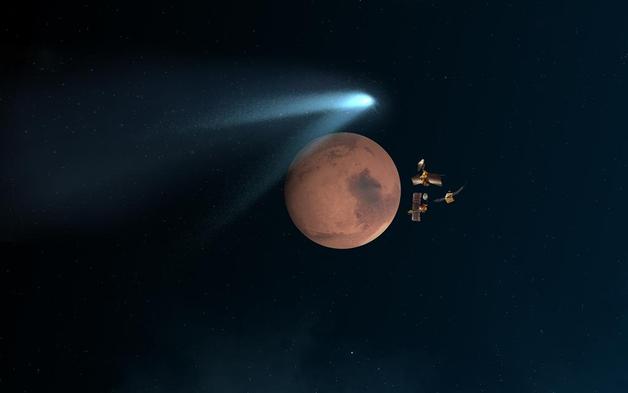
Siding Spring Mars Spacecraft : This artist's concept shows NASA's Mars orbiters lining up behind the Red Planet for their "duck and cover" maneuver to shield them fro comet dust that may result from the close flyby of comet Siding Spring (C/2013 A1) on Oct. 19, 2014. Credit: NASA/JPL-Caltech
All three NASA orbiters around Mars confirmed their healthy status Sunday after each took shelter behind Mars during a period of risk from dust released by a passing comet. Mars Odyssey, Mars Reconnaissance Orbiter and the Mars Atmosphere and Volatile Evolution (MAVEN) orbiter all are part of a campaign to study comet C/2013 A1 Siding Spring and possible effects on the Martian atmosphere from gases and dust released by the comet. The comet sped past Mars today much closer than any other known comet flyby of Mars or Earth. For more information about comet Siding Spring and the investigations of its Mars flyby, visit: http://mars.nasa.gov/comets/sidingspring/ Earth is passing through a stream of debris from Halley's Comet, source of the annual Orionid meteor shower. Forecasters expect the shower to peak on Tuesday, Oct. 21st, with as many as 25 meteors per hour. The best time to look is during the dark hours before local sunrise. [full story] [sky map] [meteor radar]
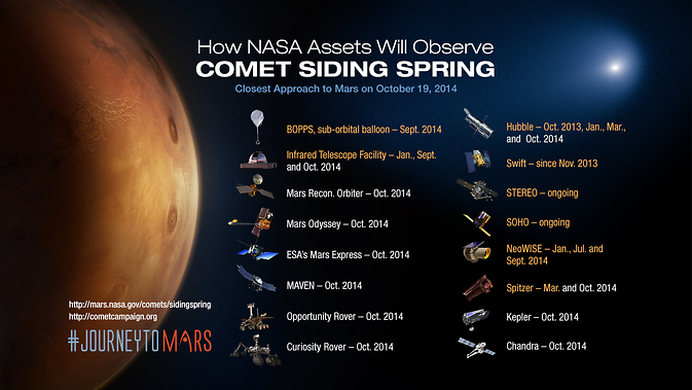 Image Credit: NASA NASA’s extensive fleet of science assets, particularly those orbiting and roving Mars, have front row seats to image and study a once-in-a-lifetime comet flyby on Sunday, Oct. 19. Comet C/2013 A1, also known as comet Siding Spring, will pass within about 87,000 miles (139,500 kilometers) of the Red Planet -- less than half the distance between Earth and our moon and less than one-tenth the distance of any known comet flyby of Earth. Siding Spring’s nucleus will come closest to Mars around 2:27 p.m. EDT, hurtling at about 126,000 mph (56 kilometers per second). This proximity will provide an unprecedented opportunity for researchers to gather data on both the comet and its effect on the Martian atmosphere. “This is a cosmic science gift that could potentially keep on giving, and the agency’s diverse science missions will be in full receive mode,” said John Grunsfeld, astronaut and associate administrator for NASA’s Science Mission Directorate in Washington. “This particular comet has never before entered the inner solar system, so it will provide a fresh source of clues to our solar system's earliest days.” Siding Spring came from the Oort Cloud, a spherical region of space surrounding our sun and occupying space at a distance between 5,000 and 100,000 astronomical units. It is a giant swarm of icy objects believed to be material left over from the formation of the solar system. Siding Spring will be the first comet from the Oort Cloud to be studied up close by spacecraft, giving scientists an invaluable opportunity to learn more about the materials, including water and carbon compounds, that existed during the formation of the solar system 4.6 billion years ago. Some of the best and most revealing images and science data will come from assets orbiting and roving the surface of Mars. In preparation for the comet flyby, NASA maneuvered its Mars Odyssey orbiter, Mars Reconnaissance Orbiter (MRO), and the newest member of the Mars fleet, Mars Atmosphere and Volatile EvolutioN (MAVEN), in order to reduce the risk of impact with high-velocity dust particles coming off the comet. The period of greatest risk to orbiting spacecraft will start about 90 minutes after the closest approach of the comet's nucleus and will last about 20 minutes, when Mars will come closest to the center of the widening trail of dust flying from the comet’s nucleus. "The hazard is not an impact of the comet nucleus itself, but the trail of debris coming from it. Using constraints provided by Earth-based observations, the modeling results indicate that the hazard is not as great as first anticipated. Mars will be right at the edge of the debris cloud, so it might encounter some of the particles -- or it might not," said Rich Zurek, chief scientist for the Mars Exploration Program at NASA's Jet Propulsion Laboratory (JPL) in Pasadena, California. The atmosphere of Mars, though much thinner that Earth's, will shield NASA Mars rovers Opportunity and Curiosity from comet dust, if any reaches the planet. Both rovers are scheduled to make observations of the comet. NASA’s Mars orbiters will gather information before, during and after the flyby about the size, rotation and activity of the comet's nucleus, the variability and gas composition of the coma around the nucleus, and the size and distribution of dust particles in the comet's tail. Observations of the Martian atmosphere are designed to check for possible meteor trails, changes in distribution of neutral and charged particles, and effects of the comet on air temperature and clouds. MAVEN will have a particularly good opportunity to study the comet, and how its tenuous atmosphere, or coma, interacts with Mars' upper atmosphere. Earth-based and space telescopes, including NASA’s iconic Hubble Space Telescope, also will be in position to observe the unique celestial object. The agency’s astrophysics space observatories -- Kepler, Swift, Spitzer, Chandra -- and the ground-based Infrared Telescope Facility on Mauna Kea, Hawaii -- also will be tracking the event. NASA’s asteroid hunter, the Near-Earth Object Wide-field Infrared Survey Explorer (NEOWISE), has been imaging, and will continue to image, the comet as part of its operations. And the agency’s two Heliophysics spacecraft, Solar TErrestrial RElations Observatory (STEREO) and Solar and Heliophysics Observatory (SOHO), also will image the comet. The agency’s Balloon Observation Platform for Planetary Science (BOPPS), a sub-orbital balloon-carried telescope, already has provided observations of the comet in the lead-up to the close encounter with Mars. Images and updates will be posted online before and after the comet flyby. Several pre-flyby images of Siding Spring, as well as information about the comet and NASA’s planned observations of the event, are available online at: http://mars.nasa.gov/comets/sidingspring Comet Siding Spring: A Close Encounter with Mars : NASA Jet Propulsion Laboratory On the night of Oct. 12th, NASA's All-Sky Meteor Network detected a piece of Halley's Comet disintegrating in the atmosphere over New Mexico. The fireball was bright enough to see through the light of a bright gibbous Moon: 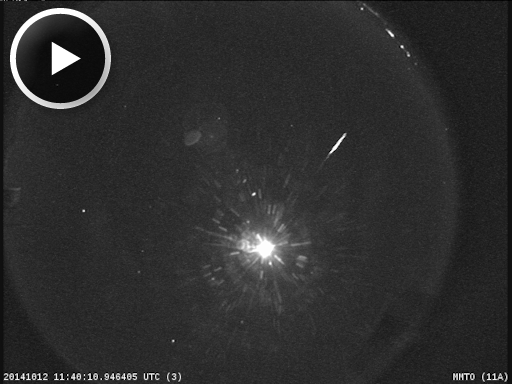
Multiple cameras tracked the meteoroid, which allowed a calculation of its trajectory: It hit Earth's atmosphere traveling 68 km/s (152,000 mph) and fully disintegrated 67.9 km above Earth's surface.
This fireball is a sign that the Orionid meteor shower is about to begin. Every year in mid- to late-October, Earth passes through a stream of debris from Halley's Comet, the parent of the Orionids. For many nights in a row, pre-dawn sky watchers can see meteors streaking out of the constellation Orion, near the Hunter's shoulder. In 2014, forecasters expect the Orionids to peak on Oct. 21-22 with 20 to 25 meteors per hour. Stay tuned for updates about meteor activity as Earth approaches the heart of the debris stream. www.spaceweather.com Europe's Rosetta probe has been at Comet 67P/Churyumov-Gerasimenko for two weeks, taking close-up pictures and making measurements of the comet's strange landscape. According to ESA, researchers now have the data they need to start picking a landing site. This weekend, mission planners will meet to consider 10 candidate locations, with the goal of narrowing the list to 5 by Monday. 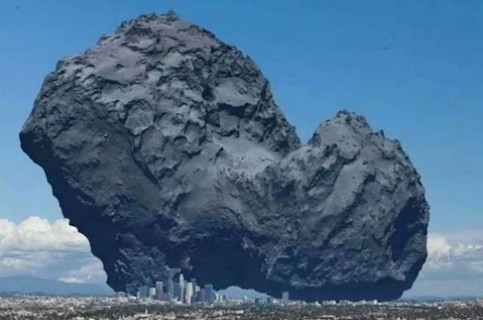
Comet 67P/Churyumov-Gerasimenko, just 3km wide. This graphic was produced to show the comet’s size, compared to the size of Los Angeles. Churyumov-Gerasimenko doesn’t cross Earth’s orbit and there is no chance of a near-Earth collision. Our sense of scale tends to adjust to circumstances. So when we think about comets it is easy to compare them with other astronomical objects. In which case comet 67P/Churyumov-Gerasimenko, just 3km wide, sounds tiny. However, as you can see in the image above, things look rather different when you compare the comet to something we are really familiar with – such as tall buildings. While Churyumov-Gerasimenko is small enough that one could walk from one end to the other fairly in less than an hour, it’s easy to forget the three dimensional nature of something like this – 3km across is no big deal, but 2km helps make sense of what happened to the dinosaurs. The image is by @quark1972, who combined a photograph of Los Angeles with an image from the Rosetta spacecraft rendezvousing with Churyumov-Gerasimenko, prior to going into orbit and eventually landing.
While Rosetta will be doing its best to touch down very gently on the comet’s surface, we can’t count on Churyumov-Gerasimenko doing the same if it ever paid LA a visit. You can get some idea of what would happen in such a collision here, although the scale of the damage depends greatly on the impact speed you choose to enter. Since Churyumov-Gerasimenko never crosses the Earth’s orbit there is no danger of a collision, at least until a close encounter with some other planet shifts its orbit. Unfortunately the same cannot be said for other, even larger, asteroids and comets. -IFLScience Thanks to: http://spaceweather.com/ and http://theextinctionprotocol.wordpress.com/2014/08/22/graphic-shows-the-immense-size-of-rosettas-comet-and-risks-such-large-objects-pose-to-earth/ The Perseid meteor shower is underway as Earth moves into the debris stream of parent comet Swift-Tuttle. According to the International Meteor Organization, the constellation Perseus is now spitting out meteors at a rate of about 20 per hour. In a normal year, those rates would increase 4- or 5-fold as the shower reaches its peak on August 12-13. But this is no normal year. In 2014, the glare of a supermoon will interfere with Perseid visibility, capping visible meteor rates at no more than ~30 per hour. Now for the good news: The Perseids are rich in fireballs, and many of those extra-bright meteors can be seen in spite of the lunar glare. NASA cameras recorded one such fireball last night over Tennessee: (video on: www.spaceweather.com) 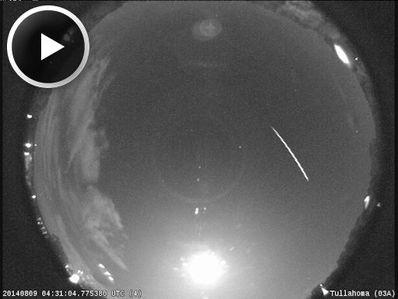 Tthe meteor cut through the moonlight wih ease. In the past week, NASA's network of all-sky cameras has recorded nearly 100 Perseid fireballs over the USA, and more are in the offing. So, note to sky watchers: Don't be put off by the supermoon.
A trip to the moonlit countryside on August 12-13 will be rewarded by a display of Perseids, albeit fewer than usual. A good time to look on those nights might be during the hours after sunset when the Moon is still hanging low in the sky and the constellation Perseus is rising in the northeast. Such an arrangement can produce a special type of meteor called an earthgrazer. Earthgrazers emerge from the horizon and skim the top of the atmosphere above the observer, a bit like a stone skipping across the surface of a pond. An hour's watching might net no more than one or two of this special kind of meteor, but that's plenty. Earthgrazers are colorful and gracefully slow, a rare beauty that makes any meteor-watch worthwhile. Got clouds? You can listen to the Perseids live on Space Weather Radio. www.spaceweather.com COMET RENDEZVOUS--TODAY! The European Space Agency's Rosetta probe has reached comet 67P/Churyumov-Gerasimenko and is maneuvering to go into orbit around the comet's core. This is an historic event. After Rosetta goes into orbit, it will follow the comet around the sun, observing its activity from point-blank range for more than a year. Moreover, in November, Rosetta will drop a lander onto the comet's strange surface. Today's events are being streamed live by the ESA. 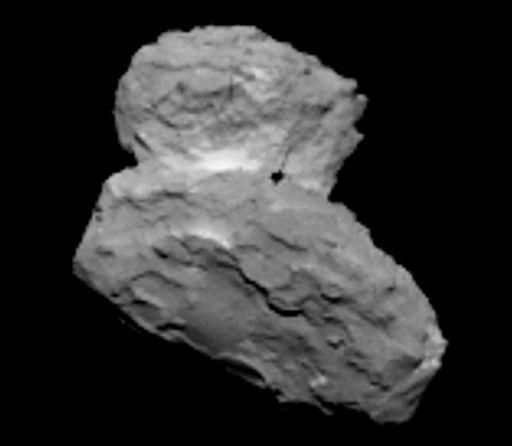
A video from ESA shows that Rosetta was programmed to match velocities with the comet's core and maneuver to within 30 km of the comet's surface, where the weak gravity of 67P could capture the spacecraft. Going into orbit around a comet is a historic moment in the history of space exploration. Good luck to the Rosetta team as they attempt this unprecedented feat.
www.spaceweather.com Anticipation is building as Earth approaches a cloud of debris from Comet 209P/LINEAR. This weekend, meteoroids hitting Earth's atmosphere could produce a never-before-seen shower called the "May Camelopardalids" peaking with as many as 200 meteors per hour. The best time to look is on Saturday, May 24th, between 0600 UT and 0800 UT (2 a.m. and 4 a.m. EDT). Earth won't be the only body passing through the debris zone. The Moon will be, too. Meteoroids hitting the lunar surface could produce explosions visible through backyard telescopes on Earth. The inset in this picture of an actual lunar meteor shows the region of the crescent Moon on May 24th that could be pelted by May Camelopardalids: 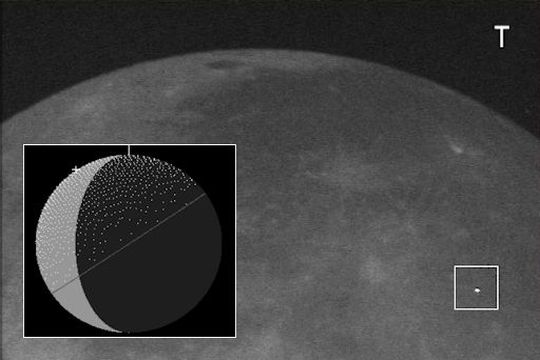
According to NASA's Meteoroid Environment Office, the best time for amateur astronomers to scan the Moon for lunar meteors is after 0800 UT (4 a.m. EDT) on May 24th.
There is much uncertainty about the strength of this shower, both on Earth and on the Moon. In recent history, our planet has never passed directly through a debris stream from Comet 209P/LINEAR, so no one knows exactly how much comet dust lies ahead. A magnificent meteor shower could erupt, with streaks of light in terrestrial skies and sparkling explosions on the Moon--or it could be a complete dud. http://spaceweather.com/ May 24th could be a big day for meteor astronomy. That's when Earth is expected to pass through a cloud of debris from comet 209P/LINEAR, producing a never-before-seen meteor shower. Meteor rates could exceed 200 per hour, and some forecasters have even mentioned the possibility of a meteor storm. Get the full story from Science@NASA. www.spaceweather.com
|
QUICK INFO
Author:
Messenger Spirit This section is for interesting items which are brought to my attention but which do not merit a separate article.
I welcome your comments, questions or suggestions on any topics you wish to contribute to this section. Please submit these on the Contact and Feedback Form PLEASE DO NOT SUBMIT COMMENTS ON THE FORM WHICH APPEARS UNDER ITEMS ON 'QUICK INFO'; THIS SYSTEM IS NOT WORKING. Categories
All
Archives
July 2024
|
 RSS Feed
