https://spaceweather.com/
|
Earth's ionosphere is a bit like Swiss cheese. It contains holes called "equatorial plasma bubbles" tens to hundreds of kilometers wide. They're invisible to the human eye. New research published in the journal Space Weather explains how machines can be trained to detect these bubbles in optical images of airglow. The technique could lead to space weather alerts for big or strangely-shaped bubbles, which can disrupt GPS navigation.
https://spaceweather.com/
0 Comments
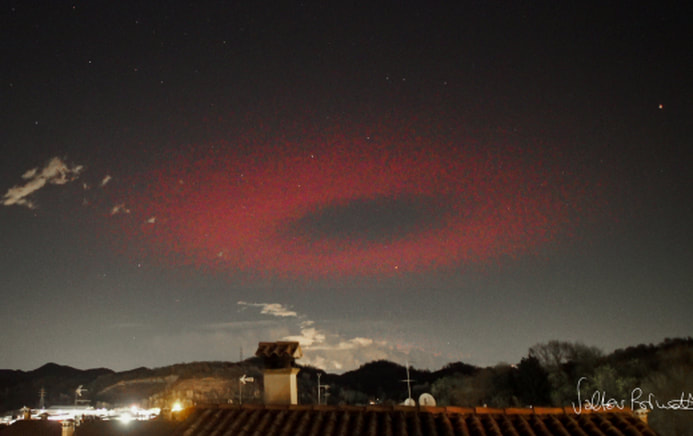
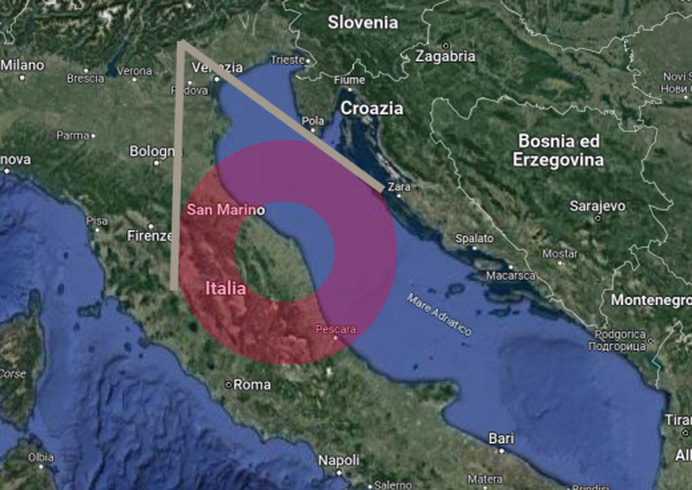
For a few milliseconds last Monday night, March 27th, an enormous red ring of light appeared in the sky over central Italy. Valter Binotto photographed it from the small town of Possagno in the foothills of the Italian Alps: This is an "ELVE"--short for Emissions of Light and Very Low Frequency Perturbations due to Electromagnetic Pulse Sources. It's a rare species of sprite discovered in 1990 by cameras onboard the space shuttle. Binotto may have just taken the best ever picture of one from the ground. "The ELVE was generated by intense lightning in a storm near Ancona about 285 km south of me," says Binotto. One bolt was so strong, it generated an intense electromagnetic pulse (EMP). The red ring marks the spot where the EMP hit Earth's ionosphere. Normal lightning bolts carry 10 to 30 kilo-ampères of current; this bolt was about 10 times stronger than normal. Binotto created a graphic showing the scale of the ELVE: "It was about 100 km high and nearly 360 km wide," says Binotto. "I have been photographing upper atmospheric lightning and transient luminous events (TLEs) since 2019, hundreds of them, and this is one of the biggest structures I have ever seen."
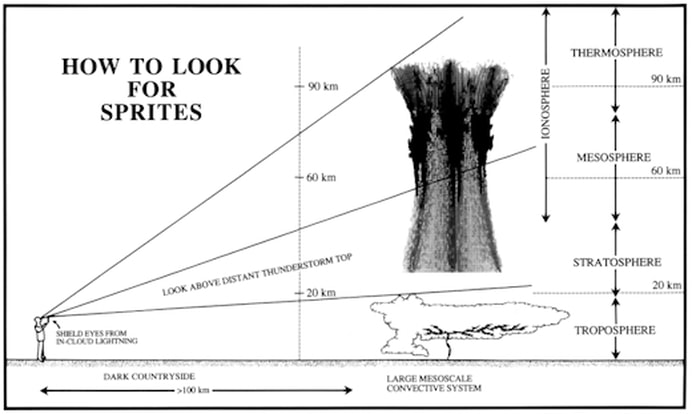
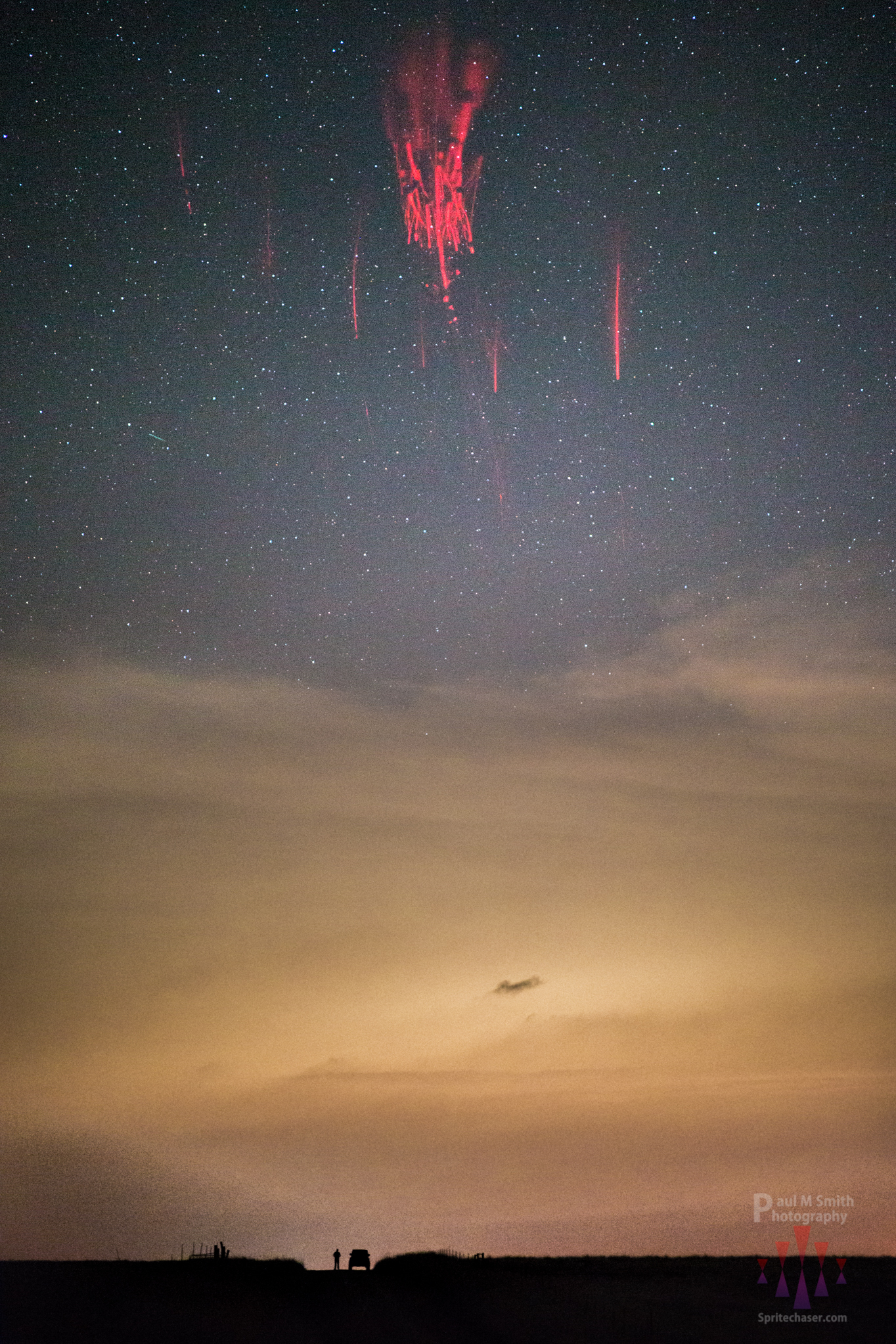
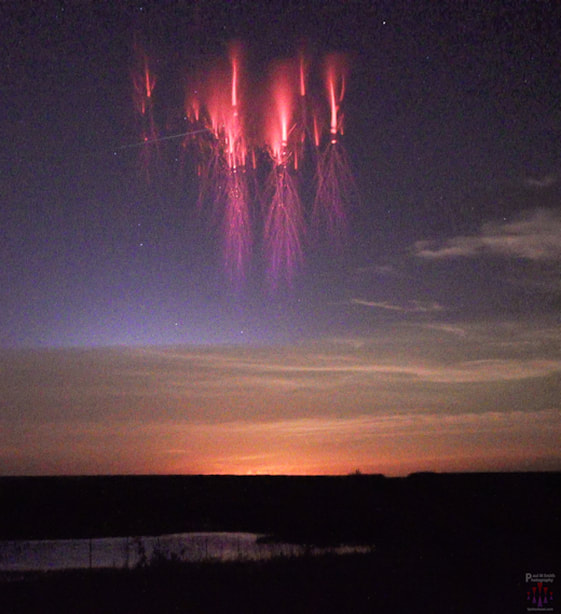
ELVE season is just getting started in Europe and North America, where spring and summer thunderstorms will multiply in the months ahead. Photographers should be alert for red rings and many other things above the cloudtops. Look here. https://spaceweather.com/ Have you ever seen a sprite? Some say it's impossible. The strange and fleeting forms of red lightning materialize above thunderheads, then disappear again in less time than it takes to blink. Yet this week veteran sprite chaser Paul Smith says he did see them: "I've watched a number with my bare eyes over the last two big storms in Kansas." Above: Naked-eye sprites over Kansas on April 28th. Credit: Paul Smith. "It has been an amazing experience that, quite honestly, has left me somewhat emotional," says Smith. "I am now convinced that before the days of light pollution, these were observed more often than we know." Sprites are an exotic form of electricity that leap up from storm clouds instead of down like ordinary lightning. Although sprites have been reported for at least a century, many scientists did not believe they existed until after 1989 when sprites were accidentally photographed by researchers from the University of Minnesota and confirmed by video cameras onboard the space shuttle. Smith has been chasing and photographing sprites for years in the stormy Great Plains around Oklahoma and Kansas. "This is the first time I have seen them with my unaided eyes," he says. "I believe that these were unusually bright." Here are two examples of clusters he caught simultaneously with his eyes and camera. His eyes registered fewer details than his camera--but he still saw plenty. "The jellyfish shapes I saw had a fiery orange/red color," he adds. "I didn't see the bottoms of the tendrils, but I had an impression of the heads and beads. Storm chasers to the west of me were also viewing with their naked eyes."
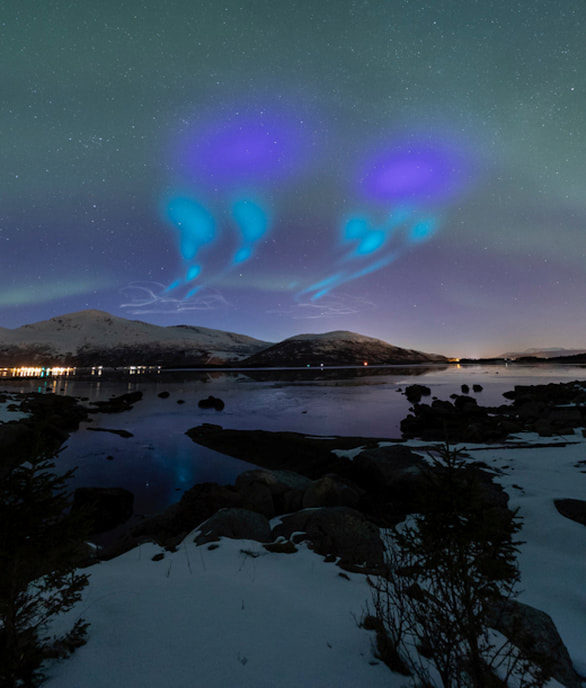
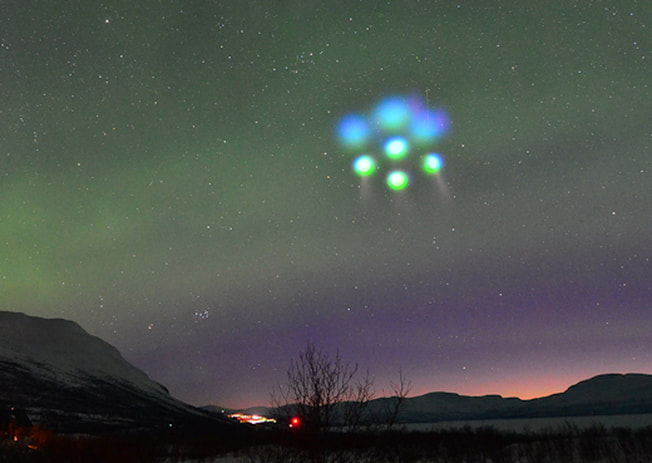
The underlying physics of sprites is still not fully understood. Some models hold that cosmic rays help them get started by creating conductive paths in the atmosphere. If cosmic rays do indeed spark sprites, now is a good time to look for them because cosmic rays are nearing a Space Age high. More examples of naked-eye sprites may be found on Smith's Facebook page. www.spaceweather.com Friday night (April 5th) in Norway, researchers at the Andøya Space Center launched two sounding rockets into a minor geomagnetic storm. The results were out of this world. Aurora tour guide Kim Hartviksen photographed glowing blobs of blue and purple caused by the rockets dumping chemical powders into the storm: Photo credit: Kim Hartviksen of Aurora Addicts "Residents for hundreds of miles were taken by surprise by these strange lights, which prompted calls to the police and 'The aliens are coming!' hysteria!" says Chris Nation who runs the Aurora Addicts guiding service. When the night began, Nation, Hartviksen, and their clients were treated to a display of auroras, ignited by a stream of solar wind buffeting Earth's magnetic field. "As the auroras started to ebb away, our friends at Andøya launched their rockets into the fading lights," says Nation. "The show began anew as the rockets released their payload into the upper atmosphere." An automated webcam operated by Chad Blakely of Lights over Lapland in Abisko, Sweden, caught the first puffs of powder emerging from the rockets. "It looked like an invasion of UFOs," says Blakley. "Soon the glowing blobs evolved into more complicated structures--like two giant squid dancing in the northern sky with an impressive aurora display as its backdrop," decribes Blakley. "Our webcam has been taking a picture every five minutes for nearly 10 years. These images are by far the most exciting I've ever seen it record."
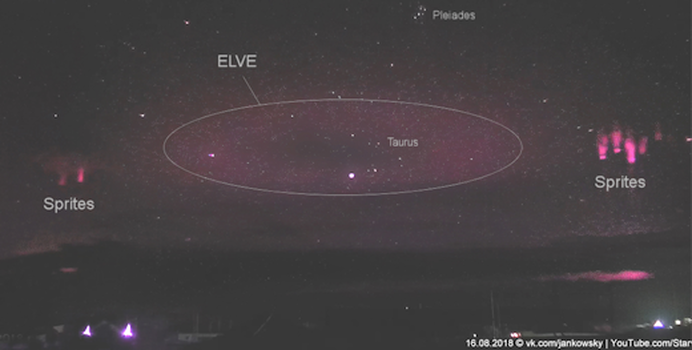
The name of the sounding rocket mission is AZURE--short for Auroral Zone Upwelling Rocket Experiment. Its goal is to measure winds and currents in the ionosphere, a electrically-charged layer of the Earth's atmosphere where auroras appear. Specifically, the researchers are interested in discovering how auroral energy might percolate down toward Earth to influence the lower atmosphere. The twin rockets deployed two chemical tracers: trimethyl aluminum (TMA) and a barium/strontium mixture. These mixtures create colorful clouds that allow researchers to visually track the flow of neutral and charged particles, respectively. According to NASA, which funded the mission, the chemicals pose no hazard to residents in the region. Update--a movie! "Here is my realtime video of the surprise rocket launch last night from NASA/ASC," reports Ole Salomonsen of Tromsø, Norway. "I was shocked when I saw this in the night sky facing north, I was not aware of the launch. www.spaceweather.com On Aug. 16th, high above a thunderstorm in central Russia, an enormous ring of light appeared in the night sky. Using a low-light video camera in the town of Irbit, amateur astronomer Ilya Jankowsky photographed the 300 km-wide donut hovering near the edge of space: "It appeared for just a split second, surrounding the horns of Taurus," says Jankowsky.
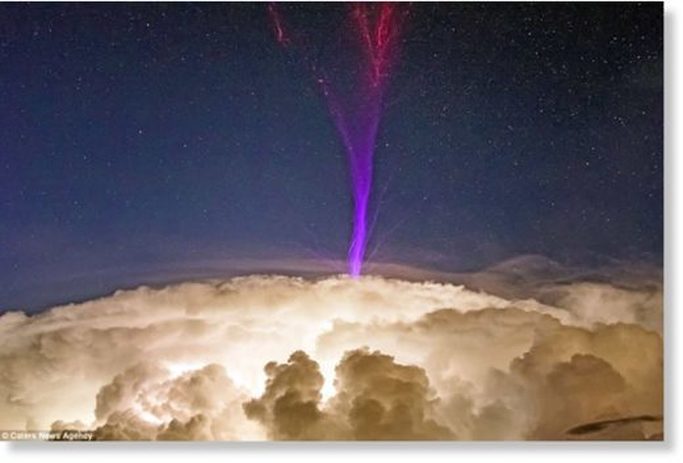
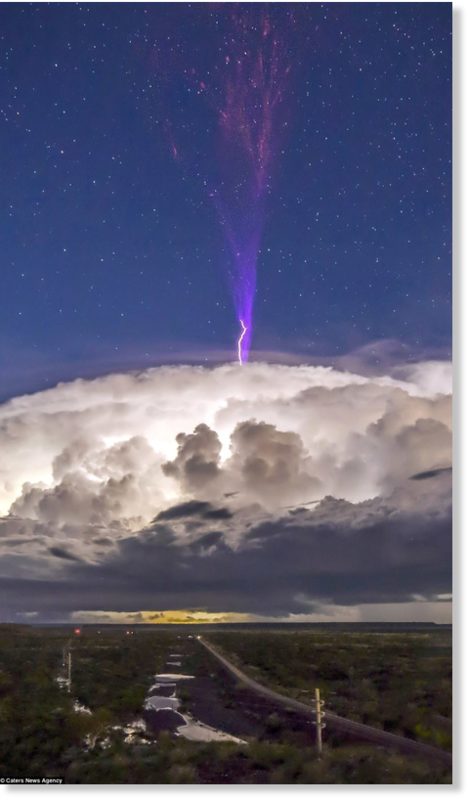
This is an example of an ELVE (Emissions of Light and Very Low Frequency Perturbations due to Electromagnetic Pulse Sources). First seen by cameras on the space shuttle in 1990, ELVEs appear when a pulse of electromagnetic radiation from cloud-to-ground lightning propagates up toward space and hits the base of Earth's ionosphere. A faint ring of deep-red light marks the broad 'spot' where the EMP hits. "For this to happen, the lightning needs to be very strong--typically 150-350 kilo-Ampères," says Oscar van der Velde, a member of the Lightning Research Group at the Universitat Politècnica de Catalunya. "For comparison, normal cloud-to-ground flashes only reach 10-30 kA." ELVEs often appear alongside red sprites, which are also sparked by strong lightning. Indeed, Jankowsky's camera caught at least two clusters of sprites dancing nearby. ELVEs are elusive--and that's an understatement. Blinking in and out of existence in only a millisecond, they are completely invisible to the human eye. For comparison, red sprites tend to last for hundredths of a second and regular lightning can scintillate for a second or more. Their brevity explains why ELVEs are a more recent discovery than other lightning-related phenomenon. Learn more about the history and physics of ELVEs here and here. www.spaceweather.com Amie Gordon : Daily Mail, UK : 05 Apr 2017 © Jeff Miles These stunning photos show the violet stream shooting out from the top of a cloud. A photographer couldn't believe his luck when he captured a rare celestial phenomenon creating a breathtaking vision against the night sky. Photographs taken in Australia depict the colourful violet stream shooting out against the deep blue of a night sky behind, while the raging storm lights up the clouds below. The phenomenon, called ionospheric lightning, occurs at much higher altitudes than normal lightening or storm clouds. Photographer Jeff Miles captured the rare sight near the small town of Pilbara in Western Australia. © Jeff Miles Upper atmospheric lightning, or ionospheric lightning, are terms used by experts to refer to a family of short-lived electrical-breakdown phenomena that occur above the altitudes of normal lightning and storm clouds. He said: 'This was a mind blowing experience to see with my eyes, never mind research the photos to find out just how rare they are. 'Gigantic jets have only been captured on camera a handful of times and this night I was lucky enough to see six jets.'
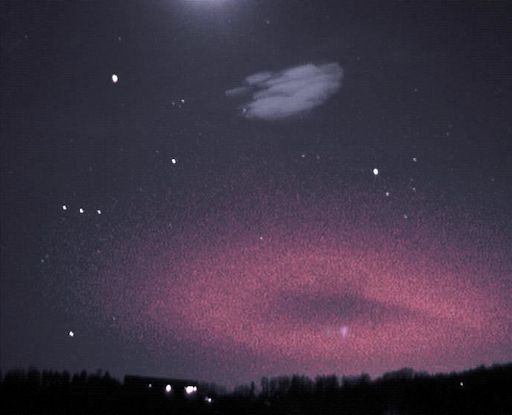
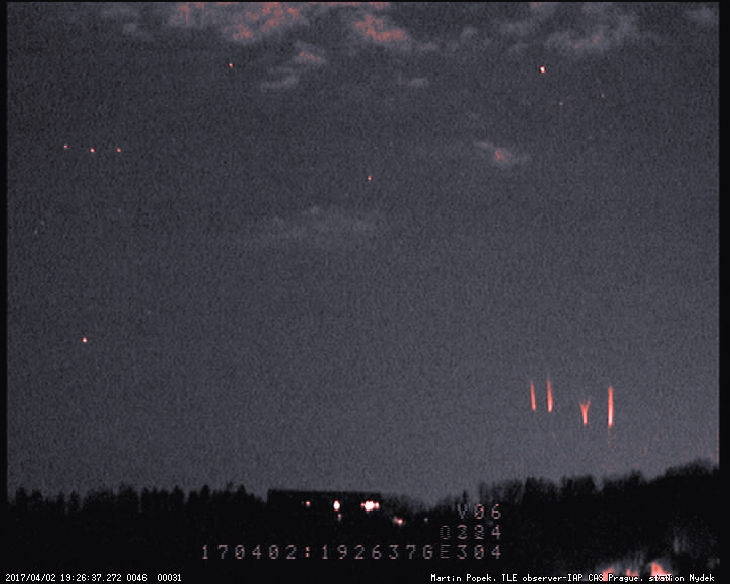
On April 2nd, high above a thunderstorm in the Czech republic, an enormous ring of light appeared in the night sky. Using a low-light video camera, amateur astronomer Martin Popek of Nýdek photographed the 300 km-wide donut hovering near the edge of space: "It appeared for just a split second alongside the constellation Orion" says Popek.
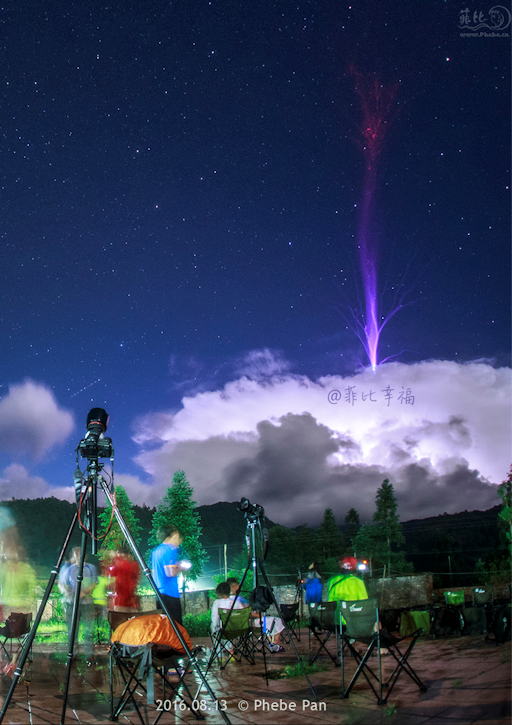
This is an example of an ELVE (Emissions of Light and Very Low Frequency Perturbations due to Electromagnetic Pulse Sources). First seen by cameras on the space shuttle in 1990, ELVEs appear when a pulse of electromagnetic radiation from cloud-to-ground lightning propagates up toward space and hits the base of Earth's ionosphere. A faint ring of deep-red light marks the broad 'spot' where the EMP hits. "For this to happen, the lightning needs to be very strong--typically 150-350 kilo-Ampères," says Oscar van der Velde, a member of the Lightning Research Group at the Universitat Politècnica de Catalunya. "For comparison, normal cloud-to-ground flashes only reach 10-30 kA." ELVEs often appear alongside red sprites, which are also sparked by strong lightning. Indeed, Popek's camera caught a cluster of sprites dancing nearby. ELVEs are elusive--and that's an understatement. Blinking in and out of existence in only 1/1000th of a second, they are completely invisible to the human eye. For comparison, red sprites tend to last for hundredths of a second and regular lightning can scintillate for a second or more. Their brevity explains why ELVEs are a more recent discovery than other lightning-related phenomenon. Learn more about the history and physics of ELVEs here and here. www.spaceweather.com On Aug. 13th in China, photographer Phebe Pan was photographing the night sky, hoping to catch a Perseid meteor. Instead, he witnessed a spectacular bolt of "space lightning". Working atop Shi Keng Kong, the highest mountain peak in the Guangdong province, "I was using a fisheye lens to capture as much of the sky as possible," says Pan. "Suddenly we saw a flash of blue and purple ejected from the top of a nearby thundercloud. It just looked like a tree with branches, and grew up very fast. So awesome!" "It just looked like a tree with branches, and grew up very fast," says Pan. "It lasted just less than one second. So awesome!"
Oscar van der Velde, a member of the Lightning Research Group at the Universitat Politècnica de Catalunya, explains what Pan saw: "This is a very lucky capture of a gigantic jet. It's the first time I've seen one captured using a fisheye lens!" Think of them as sprites on steroids: Gigantic jets are lightning-like discharges that spring from the tops of thunderstorms, reaching all the way to the ionosphere more than 50 miles overhead. They're enormous and powerful. "Gigantic jets are much more rare than sprites," says van der Velde. "While sprites were discovered in 1989 and have since been photographed by the thousands, it was not until 2001-2002 that gigantic jets were first recorded from Puerto Rico and Taiwan." Only a few dozen gigantic jets have ever been seen. Like their cousins the sprites, gigantic jets reach all the way up to the edge of space alongside meteors, noctilucent clouds, and some auroras. This means they are a true space weather phenomenon. Indeed, some researchers believe cosmic rays help trigger these exotic forms of lightning, but the link is controversial. www.spaceweather.com It was faint, brief, and enormous. On June 8th, amateur astronomer Thomas Ashcraft photographed a 300 km-wide donut of light over a thunderstorm in southeast Colorado. The video can be seen at: ELVE and Sprite June 08 2016 Southeast Colorado with Radio Scatter Reflection from Thomas Ashcraft on Vimeo. "It only lasted about a millisecond," says Ashcraft, "but it was definitely there."
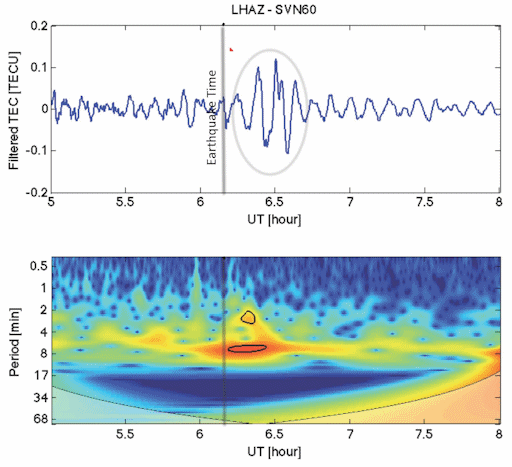
This is an example of an ELVE (Emissions of Light and Very Low Frequency Perturbations due to Electromagnetic Pulse Sources). First seen by cameras on the space shuttle in 1990, ELVEs appear when a pulse of electromagnetic radiation from lightning propagates up toward space and hits the base of Earth's ionosphere. A faint ring of light marks the broad 'spot' where the EMP hits. ELVES often appear alongside red sprites. Indeed, Ashcraft's camera caught a cluster of sprites leaping straight up through the middle of the donut. "Play the complete video to see the sprites," says Ashcraft. ELVEs are elusive--and that's an understatement. Blinking in and out of existence in only 1/1000th of a second, they are completely invisible to the human eye. For comparison, red sprites tend to last for hundredths of a second and regular lightning can scintillate for a second or more. To catch an ELVE, a high-speed video camera is required. Stay tuned for more captures as thunderstorm season unfolds. www.spaceweather.com High above Earth, more than 60 km above sea level, there is a layer of our planet's atmosphere called "the ionosphere". It is where UV radiation from the sun strips electrons away from the atoms of normal air, creating a zone of charged gas that envelopes the globe. The ionosphere is very sensitive to solar storms. Turns out, it can be sensitive to earthquakes, too. NASA is reporting that the magnitude 7.8 earthquake in Nepal on April 25th created waves of energy that penetrated the ionosphere and disturbed the distribution of electrons. Note the wave pattern, circled, in the upper panel of this ionospheric electron density plot: Basically, these are waves of electron density rippling from a point in the ionosphere above the epicenter of the quake. The waves were measured by a science-quality GPS receiver in Lhasa, Tibet. It took about 21 minutes for the waves to travel 400 miles between the epicenter and the GPS receiving station.
The bottom panel of the plot is a "dynamic spectrum." Note the hot spots outlined in black. They show that the ionosphere was ringing with periods of ~2 and ~8 minutes. Presumably, these "tones" are related to atmospheric pressure waves billowing up from the trembling Earth below. The ionosphere is the stage upon which much of space weather plays out. Auroras, meteors, and noctilucent clouds all occur there. The "Ionosphere Natural Hazards Team" at JPL studies how Earth itself affects this stage via earthquakes, volcanoes and tsunamis. You can read their report about the Nepal earthquake here. www.spaceweather.com For the past few days, the sun has been very quiet. Quiet, however, doesn't mean boring. Low solar activity can have a huge effect on Earth. During periods of sustained quiet, cosmic rays increase, space junk accumulates, and the ionosphere collapses. To learn more about the surpising potency of the spotless sun, read "The Solar Cycle Turned Sideways".
www.spaceweather.com Suspicious0bservers Published on 15 Sep 2014 www.Suspicious0bservers.org : www.ObservatoryProject.com : Aurora Video: https://vimeo.com/106051784 LINKS
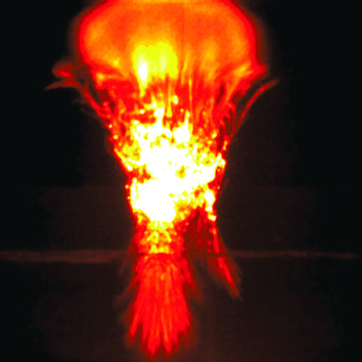
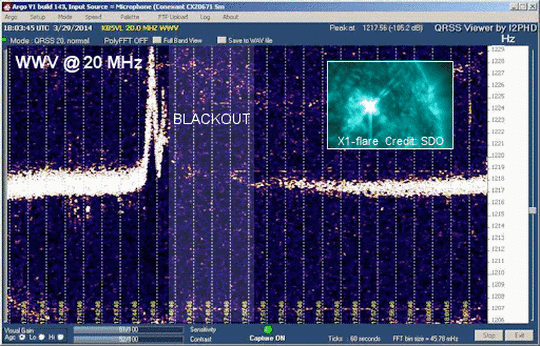
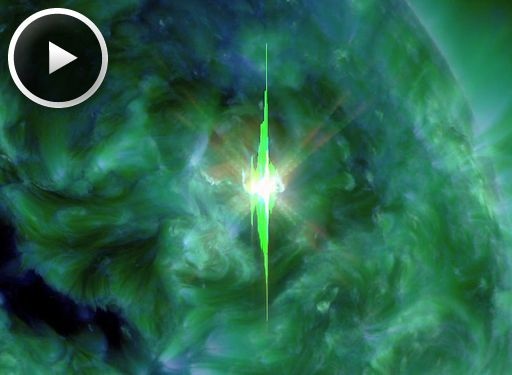
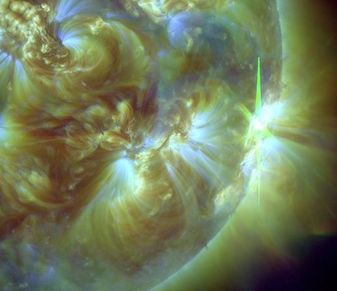
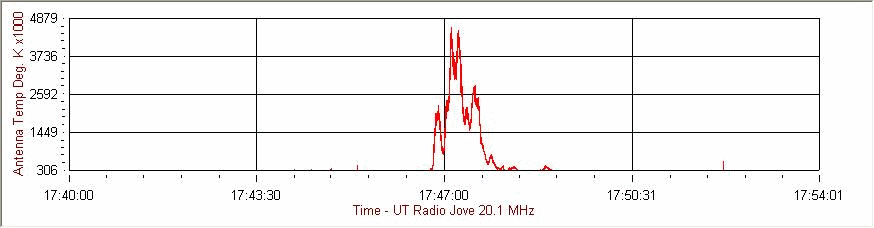
Spaceweather: http://spaceweather.com SDO: http://sdo.gsfc.nasa.gov/data/ Helioviewer: http://www.helioviewer.org/ SOHO: http://sohodata.nascom.nasa.gov/cgi-b... Stereo: http://stereo.gsfc.nasa.gov/cgi-bin/i... iSWA: http://iswa.gsfc.nasa.gov/iswa/iSWA.html NASA ENLIL SPIRAL: http://iswa.gsfc.nasa.gov:8080/IswaSy... NOAA ENLIL SPIRAL: http://www.swpc.noaa.gov/wsa-enlil/ GOES Xray: http://www.swpc.noaa.gov/sxi/goes15/i... NOAA Sunspot Classifications: http://www.swpc.noaa.gov/ftpdir/lates... GONG: http://gong2.nso.edu/dailyimages/ GONG Magnetic Maps: http://gong.nso.edu/data/magmap/ondem... By A'ndrea Elyse Messer : May 7, 2014 Photograph of a sprite. Image: H. H. C. Stenbaek-Nielsen UNIVERSITY PARK, Pa. -- Atmospheric sprites have been known for nearly a century, but their origins were a mystery. Now, a team of researchers has evidence that sprites form at plasma irregularities and may be useful in remote sensing of the lower ionosphere. "We are trying to understand the origins of this phenomenon," said Victor Pasko, professor of electrical engineering, Penn State. "We would like to know how sprites are initiated and how they develop." Sprites are an optical phenomenon that occur above thunderstorms in the D region of the ionosphere, the area of the atmosphere just above the dense lower atmosphere, about 37 to 56 miles above the Earth. The ionosphere is important because it facilitates the long distance radio communication and any disturbances in the ionosphere can affect radio transmission. "In high-speed videos we can see the dynamics of sprite formation and then use that information to model and to reproduce the dynamics," said Jianqi Qin, postdoctoral fellow in electrical engineering, Penn State, who developed a model to study sprites. Sprites occur above thunderstorms, but thunderstorms, while necessary for the appearance of a sprite, are not sufficient to initiate sprites. Not all thunderstorms and lightning strikes produce sprites. Recent modeling studies show that plasma irregularities in the ionosphere are a necessary condition for the initiation of sprite streamers, but no solid proof of those irregularities existed. The researchers studied video observations of sprites, developed a model of how sprites evolve and disappear, and tested the model to see if they could recreate sprite-forming conditions. They report their results today (May 7) in Nature Communications. Sprites resemble reddish orange jellyfish with bluish filamentary tendrils hanging down below. Careful examination of videos of sprites forming showed that their downward hanging filaments form much more rapidly than in the horizontal spread, leading the researchers to suggest that localized plasma irregularities cause the streamers to propagate. Read the entire article at: http://news.psu.edu/story/314975/2014/05/07/research/sprites-form-plasma-irregularities-lower-ionosphere On Saturday, March 29th, the magnetic canopy of sunspot AR2017 erupted, producing a brief but intense X1-class solar flare. A flash of extreme UV radiation sent waves of ionization rippling through Earth's upper atmosphere and disturbed the normal propagation of terrestrial radio transmissions. Radio engineer Stan Nelson of Roswell, NM, was monitoring WWV at 20 MHz when the signal wobbled then disappeared entirely for several minutes: "The Doppler shift of the WWV signal (the 'wobble' just before the blackout) was nearly 12 Hz, the most I have ever seen," says Nelson. The flare not only blacked out radio signals, but also produced some radio signals of its own. The explosion above sunspot AR2017 sent shock waves racing through the sun's atmosphere at speeds as high as 4800 km/s (11 million mph). Radio emissions stimulated by those shocks crossed the 93 million mile divide to Earth, causing shortwave radio receivers to roar with static. Here is a plot of the outburst detected by Nelson using a 20.1 MHz RadioJove receiver. Elsewhere, strong bursts were recorded at frequencies as high as 2800 MHz. It was a very broad band event. NASA's Solar Dynamics Observatory recorded a beautiful movie of the flare: The flash you just saw was extreme UV radiation, the type of radiation that ionizes the upper layers of our atmosphere. In this case, the ionizing action of the flare led to a rare magnetic crochet, measuring 17 nT at the magnetometer in Boulder, Colorado.
A magnetic crochet is a ripple in Earth's magnetic field caused by electrical currents flowing in air 60 km to 100 km above our heads. Unlike geomagnetic disturbances that arrive with CMEs days after a flare, a magnetic crochet occurs while the flare is in progress. They tend to occur during fast impulsive flares like this one. The magnetic field of sunspot AR2017 is decaying now, but it still poses a threat for eruptions. www.spaceweather.com http://wavechronicle.com/wave/?p=1151
Author: Ben Davidson ('Suspicious Observer' : See also Ben's latest video below) In 1986, some scientists laughed as other scientists seriously pondered the existence of water on Mars. Today we know that there is ice, and even the potential for liquid water on the surface of Mars. That news made headlines, especially with the newest rover sending back close-up images and data from direct samples. The vast majority of relevant and more-surprising information on the topic of extraplanetary water has managed to go under the radar. Additionally, breakthroughs in extreme-environment chemistry, astronomy, physics, and more have not yet been expressly interconnected to draw new hypothetical inferences about the nature of the universe, and the abundance of life. In STARWATER, an educational documentary outlining the relevant research about water outside earth, we examine the wide range of places to find water, and why this is likely to be true everywhere. Would you believe that we have proof of water on every planet? We discovered permanent ice near the poles of Mercury, many moons of Jupiter and Saturn are icy spheres with liquid oceans beneath the surface, the centers of Neptune and Uranus are icy materials, and Pluto is mostly made of water ice. That’s right, earth does not have the only liquid water oceans in the solar system, and Pluto is a ball of frozen water. It gets better… We found water vapor in sunspots, in massive quantities in pre-planetary and pre-stellar nebulae, and surrounding black holes. We have even discovered some exoplanets that appear to have watery atmospheres, based on spectral emission. Surrounding our solar system, and other stars as well, we find a pseudo-shell of rocks and ice that mark the boundary of the solar wind. This icy shell explains a good deal of the water found in our solar system, and likely found in others. The solar wind has been discovered to contain nearly every known element, a startling revelation about elemental production, but it is mostly comprised of hydrogen and hydrogen ions. Recent breakthroughs have shown that the solar wind can liberate oxygen trapped in space rocks, moons, planets, etc., and then combine with that oxygen to form water. This discovery came within weeks of another one- that interplanetary dust carries space water, and potentially, organic materials, down to all materials in the solar system. Why should it stop at our neighborhood? It shouldn’t, and neither should it stop at the solar wind characteristics of our star or its ability to radiologically create water from the rocks. NASA has discovered that Earth’s upper ionosphere erupts enormous amounts of oxygen during impact from coronal mass ejections (CME) from the sun. This oxygen does not need to be liberated from rocks; it’s “ready to go” and has an abundance of solar wind particles in the impacting CME with which to create water. What do these breakthroughs tell us? Our star is a raw-materials distribution center for everything touched by its solar wind. Rocky bodies are going to have water, and are more likely to have oxygen-rich atmospheres for the same reason of oxygen liberation. Those oxygen-rich atmospheres are conceivably the best method for water production in the known universe; our planet’s reaction to the solar hydrogen is to toss out a shield of oxygen. You can read the rest of this article at : http://wavechronicle.com/wave/?p=1151 The papers, scientists, discoveries, and revelations are explored in the STARWATER series, available for members at Suspicious0bservers.org, but the research and resources to private material are always made free for everyone here. |
QUICK INFO
Author:
_Messenger Spirit This section is for interesting items which are brought to my attention but which do not merit a separate article.
I welcome your comments, questions or suggestions on any topics you wish to contribute to this section. Please submit these on the Contact and Feedback Form PLEASE DO NOT SUBMIT COMMENTS ON THE FORM WHICH APPEARS UNDER ITEMS ON 'QUICK INFO'; THIS SYSTEM IS NOT WORKING. Categories
All
Archives
November 2025
|

RSS Feed