(6 sporadics)
https://spaceweather.com/
| Ascension Now |
|
|
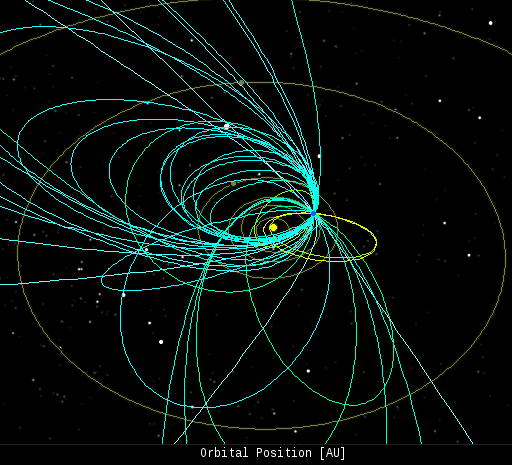
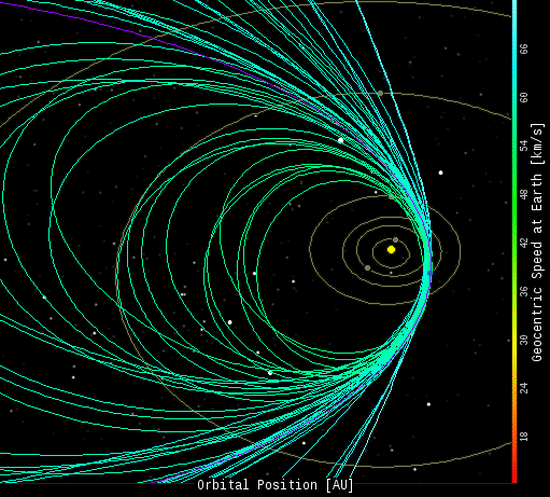
Every night, a network of NASA all-sky cameras scans the skies above the United States for meteoritic fireballs. Automated software maintained by NASA's Meteoroid Environment Office calculates their orbits, velocity, penetration depth in Earth's atmosphere and many other characteristics. Daily results are presented here on Spaceweather.com. On Jan. 27 2026, the network reported 6 fireballs. (6 sporadics) In this diagram of the inner solar system, all of the fireball orbits intersect at a single point--Earth. The orbits are color-coded by velocity, from slow (red) to fast (blue). [Larger image] [movies]
https://spaceweather.com/
0 Comments
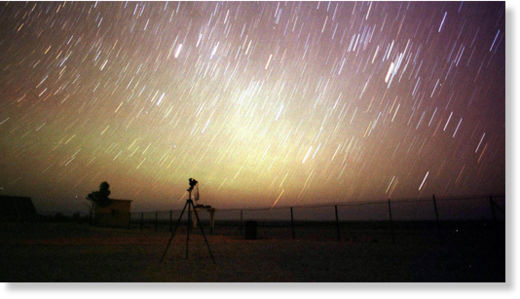
RT : 17 Nov 2015 © Jali Jarekji / Reuters Stars outnumber Leonid meteors lighting up the night sky of the desert near Amman. A stunning fireworks show will be thrown by Mother Nature overnight on Tuesday 17 November, as the Leonid meteor shower sends out a series of spectacular fireballs and shooting stars. The annual lights show contains some of the fastest meteors in existence. "Leonids travel at speeds of 71 km (44 miles) per second, and are considered to be some of the fastest meteors out there," NASA said in a statement.
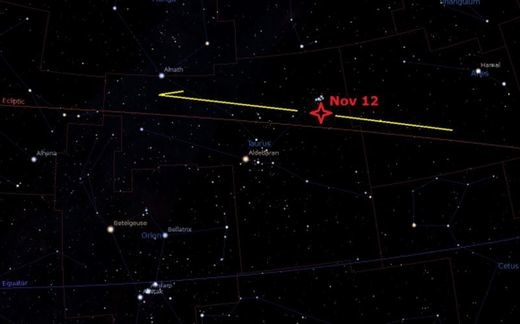
Skywatchers hoping to see the light show with their own eyes are in luck, according to NASA, which says that a "waxing-crescent moon will set before midnight, leaving dark skies to view these bright and colorful meteors." Those who want a front-row seat should head outdoors at around midnight, local time, says NASA. "Find an area well away from city or street lights...orient yourself with your feet towards east, lie flat on your back, and look up, taking in as much of the sky as possible," the space agency wrote online, noting that the show will last until dawn. But although the Leonid shower has produced tens of thousands of meteors per hour in the past, this year's event won't be quite as remarkable. Viewers should at most expect 10 to 20 meteors per hour, according to Space.com. The Leonids are created when Earth travels through a trail of debris shed by Comet Tempel-Tuttle. However, since the comet is now just about as far from the sun as it gets during its roughly 33-year orbit, there's not a lot of debris for Earth to collide with - which results in a less impressive meteor shower than previous years. Those with compromised views due to clouds or light pollution can watch the meteor shower online, via a Leonids webcast hosted by the Slooh Community Observatory, which will take place at 01:00 GMT on Wednesday. The webcast will feature live shots from five different countries on four continents. David Dickinson : Universe Today : 29 Oct 2015 © Stellarium The motion of the radiant of the Northern Taurid meteors from mid-October through mid-November. The shower typically peaks around November 12th annually. Asteroid 2015 TB145 isn't the only cosmic visitor paying our planet a trick-or-treat visit over the coming week. With any luck, the Northern Taurid meteor shower may put on a fine once a decade show heading into early November. About once a decade, the Northern Taurid meteor stream puts on a good showing. Along with its related shower the Southern Taurids, both are active though late October into early November. Specifics for 2015 This year sees the Moon reaching Full on Tuesday October 27th, just a few days before Halloween. The Taurid fireballs, however, have a few things going for them that most other showers don't. First is implied in the name: the Northern Taurids, though typically exhibiting a low zenithal hourly rate of around 5 to 10, are, well, fireballs, and thus the light-polluting Moon won't pose much of a problem. Secondly, the Taurid meteor stream is approaching the Earth almost directly from behind, meaning that unlike a majority of meteor showers, the Taurids are just as strong in the early evening as the post midnight early morning hours. As a matter of fact, we saw a brilliant Taurid just last night from light-polluted West Palm Beach in Florida, just opposite to the Full Moon and a partially cloudy sky. In stark contrast to the swift-moving Orionids from earlier this month, expect the Taurid fireballs to trace a brilliant and leisurely slow path across the night sky, moving at a stately 28 kilometre per second (we say stately, as the October Orionids smash into our atmosphere at over twice that speed!). © NASA A 2013 Taurid fireball captured by an All-Sky cam, plus a near-Full Moon. Ever since the 2005 event, the Northern Taurids seemed to have earned the name as "The Halloween Fireballs" in the meme factory that is the internet. It's certainly fitting that Halloween should have its very own pseudo-apocalyptic shower. The last good return for the Northern Taurids was 2005-2008, and 2015 may see an upswing in activity as well. Obviously, something interesting has to be occurring on Comet 2P Encke—the source of the two Taurid meteor streams—to shed the pea-sized versus dust-sized material seen in the Southern and Northern Taurids. With the shortest orbital period 3.3 years of all periodic comets known, the Taurid meteor stream—like Encke itself—follows a shallow path nearly parallel to the ecliptic plane. Discovered in 1822 by astronomer Johann Encke, Comet 2P Encke has been observed through many perihelion passages over the last few centuries, and passes close to Earth once 33 years, as it last did in 2013. Read more here. Earth is entering a stream of debris from Comet Swift-Tuttle, source of the annual Perseid meteor shower. Forecasters expect meteor rates to peak at 100+ per hour on the night of Aug. 12-13 when our planet passes through the heart of the debris stream. Perseids produce more fireballs than any other meteor shower of the year, so stay tuned for a good show. [meteor radar] www.spaceweather.com
Geminid meteor activity is picking up as Earth moves deeper into the debris stream of rock comet 3200 Phaethon. During the past 48 hours, NASA's network of all-sky cameras have detected 40 Geminid fireballs over the USA. Last night, this one disintegrated inside a Moon halo over the Kitt Peak National Observatory in Arizona:
The sigma Hydrid meteor shower is underway. Peaking every year in early December, this minor shower is caused by debris from an unknown comet. The display in December 2014 may be less minor than usual. Over the weekend NASA's network of all-sky meteor cameras detected 9 sigma Hydrid fireballs over the USA.
Sky watchers are encouraged to be alert for fast meteors emerging from the head of the serpent (constellation Hydra) during the hours between local midnight and dawn. [meteor radar] www.spaceweather.com Mark your calendar: The annual Geminid meteor shower, caused by rock comet 3200 Phaethon, peaks this year on Dec. 14th. On that date, dark-sky observers around the world could see as many as 120 meteors per hour. As November comes to a close, Earth is entering the outskirts of 3200 Phaethon's debris stream, causing a slow drizzle of meteors weeks ahead of peak night. The first Geminid fireball of the season was detected over the USA on Nov. 26th by NASA's network of all-sky meteor cameras. www.spaceweather.com
Asteroid Fear: Gaia Satellite sent into Space to monitor blind zone between Sun and Earth23/10/2013 Emily Fox. The Express, UK : Sun, 20 Oct 2013 13:44 CDT A state of the art satellite is being sent into space to monitor the blind zone between the Earth and the sun to warn of incoming asteroids. Astronomers have previously not been able to spot asteroids in the 'blind zone' due to radiation from the sun blocking information. But now The European Space Agency intends to launch the Gaia Space Telescope with its key task being to monitor the area between the Earth and the sun and warn of any impending collisions. One recent asteroid which could have been spotted as it travelled through the 'blind zone' months before it collided with the Earth, was that of the Russian asteroid of February this year which caused a spectacular fireball before smashing into Chelyabinsk, 900 miles east of Russia. Gerry Gilmore, professor of experimental philosophy at Cambridge University's Institute of Astronomy told the Sunday Times: "Gaia will measure all the asteroids including those between us and the sun which are the really nasty ones because we can't see them." During its five-year-mission the £800 million Gaia will also map the stars with unprecedented precision - giving astronomers the first accurate 3D map of our galaxy and measure distance between the stars. A spokseman for the ESA said: "During its anticipated lifetime of five years, Gaia will observe each of its 1billion sources about 70 times, resulting in a record of the brightness and position of each source over time. "Together with the unprecedented accuracy of the astrometric measurements, this will lead to the discovery of planets around other stars, asteroids in our Solar System, icy bodies in the outer Solar System, brown dwarfs, and far-distant supernovae and quasars. The list of Gaia's potential discoveries makes the mission unique in scope and scientific return." The satellite completed final preparations in Europe last year and will take off from a launch site in French Guiana on November 20. http://www.sott.net/article/267825-Asteroid-fear-Gaia-satellite-sent-into-space-to-monitor-blind-zone-between-sun-and-Earth NEW: Every night, a network of NASA all-sky cameras scans the skies above the United States for meteoritic fireballs. Automated software maintained by NASA's Meteoroid Environment Office calculates their orbits, velocity, penetration depth in Earth's atmosphere and many other characteristics. Daily results are presented here on Spaceweather.com. On Oct. 21, 2013, the network reported 34 fireballs. (15 Orionids, 13 sporadics, 4 Leonis Minorids, 2 epsilon Geminids) In this diagram of the inner solar system, all of the fireball orbits intersect at a single point--Earth. The orbits are color-coded by velocity, from slow (red) to fast (blue). [Larger image] [movies] www.spaceweather.com
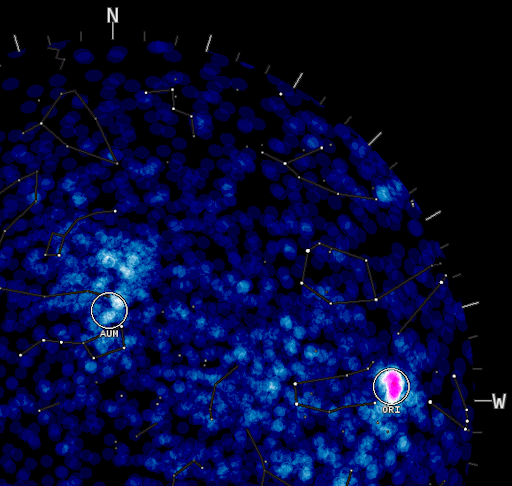
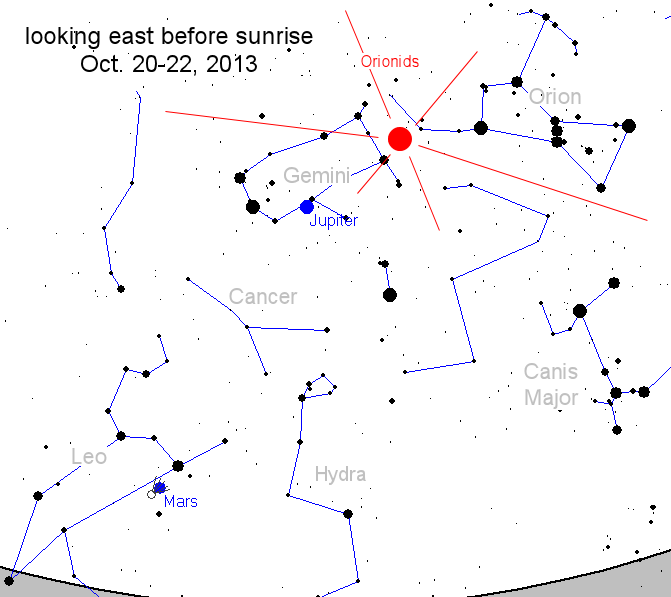
Earth is passing through a stream of debris from Halley's Comet, source of the annual Orionid meteor shower. Last night NASA's All-Sky Fireball Network detected 15 Orionid fireballs over the United States. After sunrise, the Canadian Meteor Orbit Radar (CMOR) continued to record echoes from Orionids in broad daylight. This CMOR sky map shows the Orionid radiant (ORI) clearly active at 1445 UT on Oct. 21st: Forecasters expect the shower to peak on Oct. 21st with about 20 meteors per hour. However, Halley's debris stream is broad, so Orionid activity could spill into Oct. 22nd. The best time to look is during the hours before local sunrise when the constellation Orion is high in the sky. [meteor radar] [sky map] www.spaceweather.com
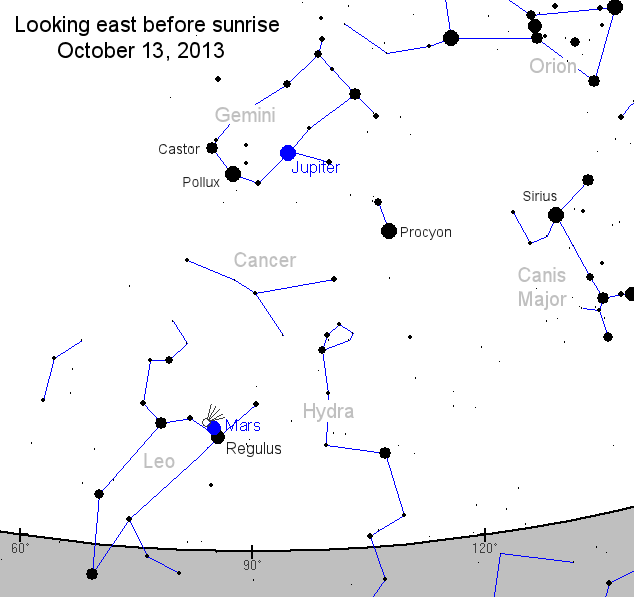
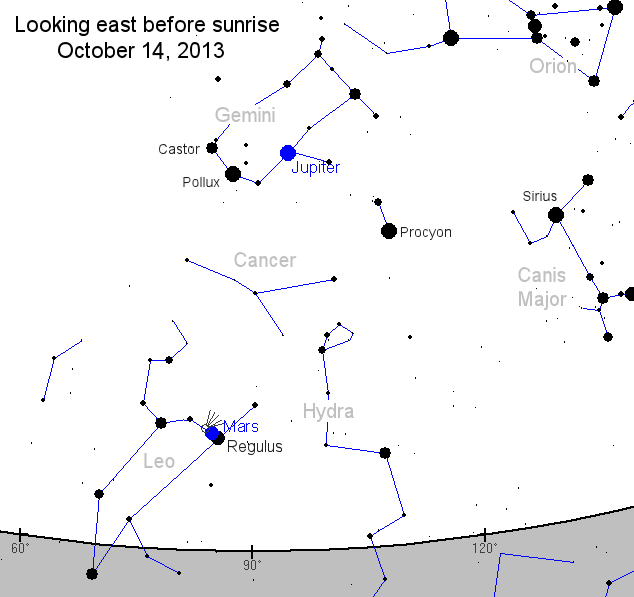
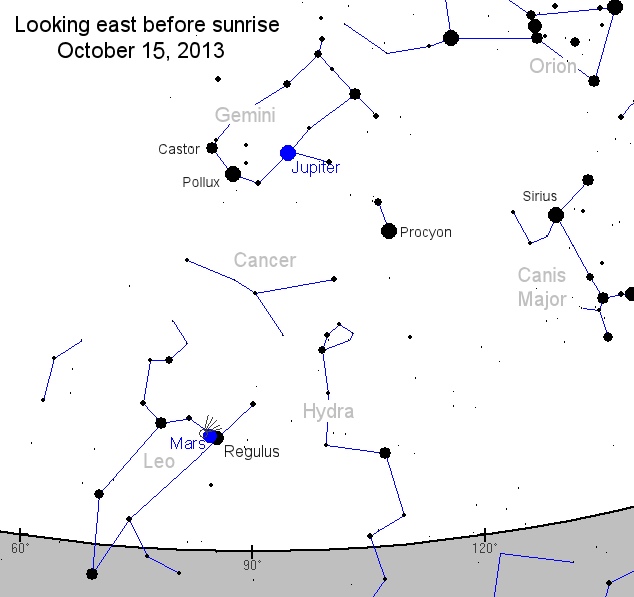
Mars, the 1st-magnitude star Regulus, and Comet ISON have gathered together in the pre-dawn sky only a few degrees apart. Comet ISON is invisible to the naked eye, but Mars and Regulus are bright enough to see without optics. They form a pretty red-blue "double star" that can lead telescopic observers to the comet. Sky maps: Oct. 13, 14, 15. EARLY ORIONIDS: Earth is entering the outskirts of a debris stream from Halley's comet, source of the annual Orionid meteor shower. Last night, Oct. 12th, cameras in NASA's All-Sky Fireball Network detected two bright Orionid fireballs over the United States. The shower is expected to peak this year on Oct. 21st with ~20 meteors per hour between local midnight and dawn. An almost-full Moon on peak night will sharply reduce visibility, so watch out for the early Orionids. They might be the only ones you see.
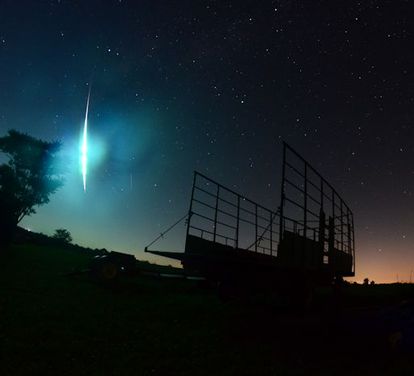
www.spaceweather.com On Sept. 27th, a meteor exploded in the skies above the US midwest. Witnesses report shadows cast upon the ground, unusual sounds, and a swirling contrail marking the aftermath of the blast. "It was the most brilliant fireball that I have ever seen!" reports Angela McClain, who sends this picture from Faith Ranch in Jewett, Ohio: "The entire landscape lit up," she continues. "I spun around and there it was, a huge, bright green light, streaking across the sky. Even when it was gone, there was still a bright line in the sky about 20 seconds later. We were all stunned."
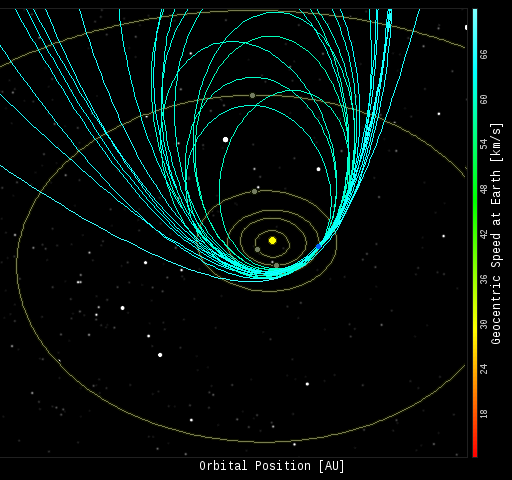
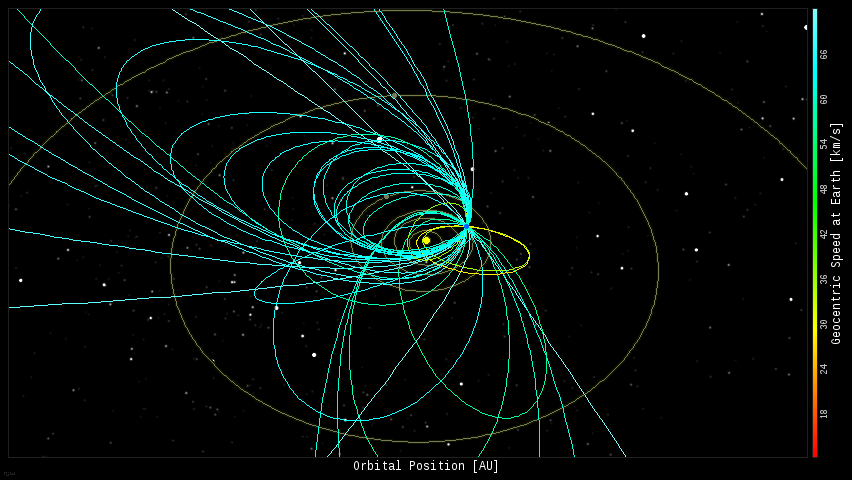
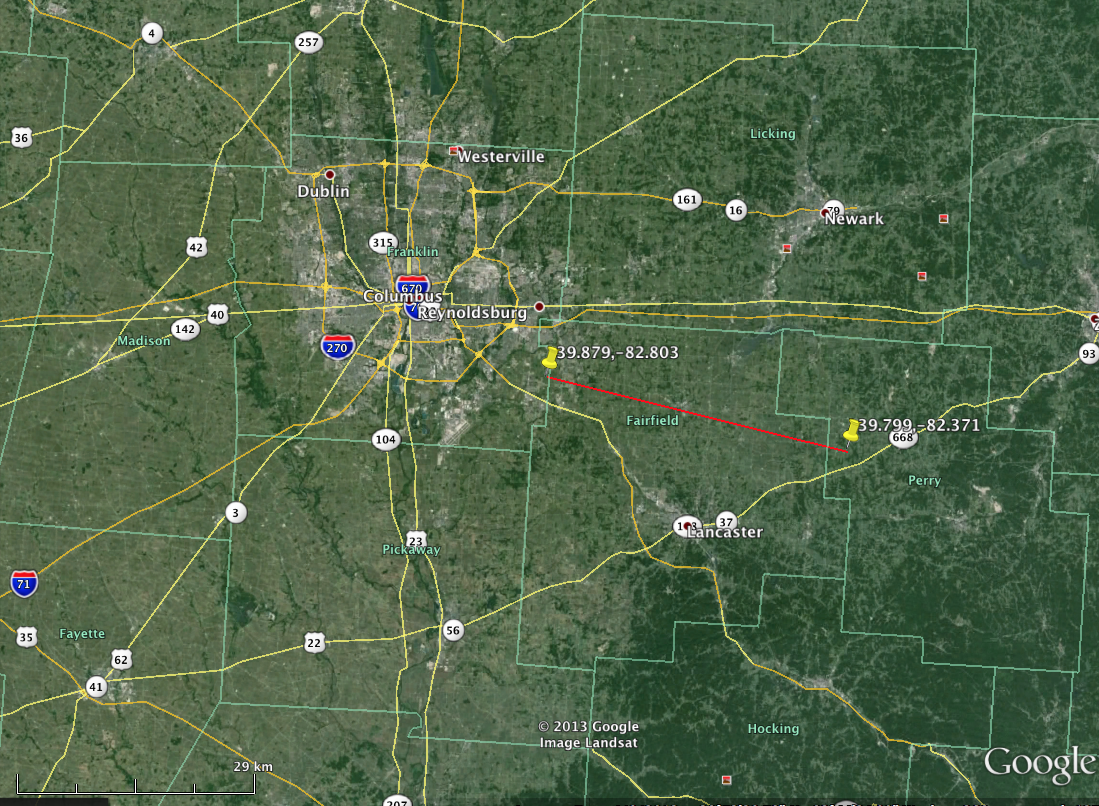
A NASA all-sky camera in Hiram, Ohio, also recorded the fireball: movie. "This was a very bright event," says Bill Cooke of NASA's Meteoroid Environment Office. "Flares saturated our meteor cameras, and made determination of the end point (the terminus of the fireball's flight through the atmosphere) virtually impossible. Judging from the brightness, we are dealing with a meteor class object." Data from multiple cameras shows that the meteoroid hit Earth's atmosphere traveling 51 km/s (114,000 mph) and passed almost directly over Columbus, Ohio. Cooke has prepared a preliminary map of the ground track. According to the American Meteor Society, the fireball was visible from at least 14 US states. www.spaceweather.com European sky watchers are reporting an outburst of September epsilon Perseid meteors. "The outburst occurred around UT midnight on Sept. 9-10," says Bill Cooke, head of NASA's Meteoroid Environment Office. "During a two hour period, meteors appeared at a rate equivalent to ~50 per hour (ZHR). We did not see the outburst in North America because it was still daylight at the time." NASA all-sky cameras have been recording epsilon Perseid fireballs for days, albeit at a much lower rate than what the Europeans saw. The shower has been active since early September, allowing Cooke's team to calculate orbits for more than a dozen meteoroids: In the diagram, orbits are color-coded by velocity. Epsilon Perseid meteoroids hit Earth's atmosphere at a "blue-green" speed of about 62 km/s (139,000 mph). According to NASA data, the debris stream appears to be rich in fireball-producing meteoroids.
The epsilon Perseid shower peaks every year around this time, but the shower is not well known because it is usually weak, producing no more than 5 meteors per hour. In 2008 the shower surprised observers with an outburst five times as active, and this year the shower may have doubled even that. Clearly, the epsilon Perseid debris stream contains some dense filaments of material that Earth usually misses but sometimes hits. No one knows the source of the September epsilon Perseid meteor shower. Whatever the parent is, probably a comet, its orbit must be similar to the green ellipses shown in the orbit-map above. As NASA cameras continue to gather data on this shower, orbital parameters will become more accurately known, possibly leading to a match. Meanwhile, sky watchers should be alert for more epsilon Perseids in the nights ahead. The shower is waning but still active and more outbursts are possible. http://spaceweather.com/ NASA's Meteoroid Environment Office has upgraded its estimates of a major fireball that exploded over the southeastern USA around 2:30 AM on August 28th. Lead researcher Bill Cooke says "the fireball reached a peak apparent magnitude of -16, about 20 times brighter than a Full Moon, and cast shadows on the ground. This indicates that the meteoroid had a mass of more than 110 kg (240 lbs) and was up to a meter in diameter. It hit the top of Earth's atmosphere traveling 25 km/s (56,000 mph)." (see movie in previous entry, below)
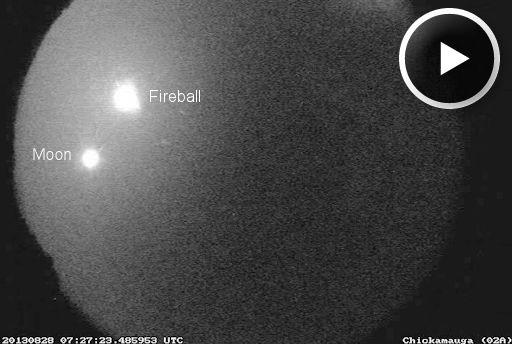
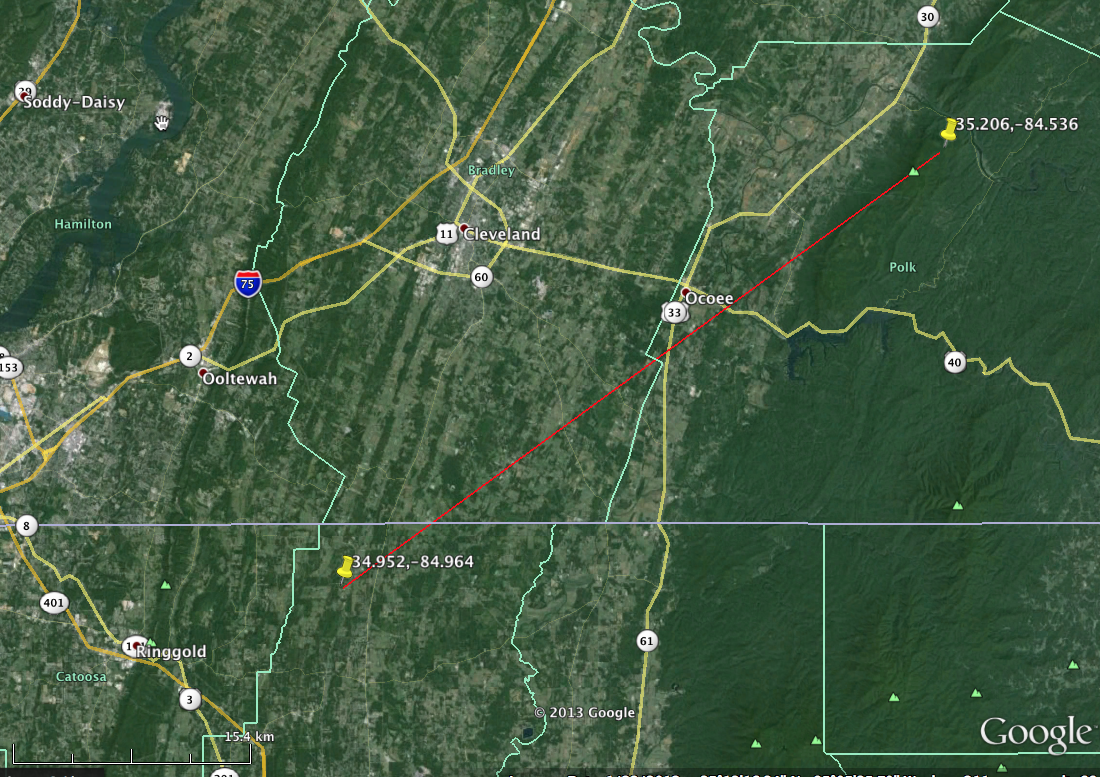
"This is the brightest event our network has observed in 5 years of operation," he continues. "There are reports of sonic booms reaching the ground, and data from 4 doppler radars indicate that some meteorites may have fallen along the fireball's ground track." (Note: The city in the ground track map is Cleveland, Tennessee, not Cleveland, Ohio.) An initial calculation of the fireball's orbit suggested it might be a fragment from a Jupiter family comet. Improved estimates of the orbital parameters point to a different kind of object: a main belt asteroid. If meteorites are recovered from the Tennessee countryside, their chemical composition will tell researchers more about the origin of the fireball. www.spaceweather.com QUIET SUNSPOTS, ACTIVE FILAMENT: None of the sunspots on the Earthside of the sun is actively flaring. Technically, this means solar activity is "low." Nevertheless, a large magnetic filament in the sun's southern hemisphere erupted during the early hours of August 29th: movie. The CME it hurled into space might have an Earth-directed component. Stay tuned for updates. MAJOR FIREBALL EVENT: Bill Cooke of NASA Meteoroid Environment Office reports that a major fireball event occurred over the southeastern USA on August 28th. The explosion was brighter than the Moon and it might have scattered meteorites on the ground. Watch the movie (on www.spaceweather.com), then read Cooke's full report below: "On August 28 at 07:27 UTC (2:27 AM local time in Alabama), all six NASA all-sky cameras in the southeast picked up a very bright fireball," he says. "Its peak magnitude was approximately -11, or six times brighter than the Last Quarter Moon. This may very well be the brightest event our network has observed in 5 years of operation."
"The cameras were completely saturated, necessitating a manual solution of the fireball's trajectory and orbit," he adds. Initial results indicate that the meteoroid massed 45 kg (roughly 0.3 to 0.4 meters in diameter) and hit the top of Earth's atmosphere traveling 23.7 km/s (53,000 mph). Cooke is currently examining doppler radar records and other data to determine where the fall zone is located. www.spaceweather.com |
QUICK INFO
Author:
_Messenger Spirit This section is for interesting items which are brought to my attention but which do not merit a separate article.
I welcome your comments, questions or suggestions on any topics you wish to contribute to this section. Please submit these on the Contact and Feedback Form PLEASE DO NOT SUBMIT COMMENTS ON THE FORM WHICH APPEARS UNDER ITEMS ON 'QUICK INFO'; THIS SYSTEM IS NOT WORKING. Categories
All
Archives
January 2026
|